

Shopify vs BigCommerce; 9+ Keys Comparison 2026
Picking the right ecommerce platform is one of the most consequential decisions an online business owner can make. Get it right, and you have a solid foundation that grows with your ambitions. Get it wrong, and you will be spending weekends migrating data, losing sales, and pulling your hair out over transaction fees.
Two platforms dominate the conversation in 2026: Shopify vs BigCommerce. Both are robust, cloud-hosted solutions that allow you to build, manage, and scale an online store without touching a single server. But beneath the surface, they are built for different kinds of sellers, different priorities, and different growth paths.
This in-depth comparison covers everything from pricing and ease of use to SEO capabilities, payment gateways, scalability, and who each platform is truly best suited for. By the end, you will know exactly which one deserves your business.
Quick Comparison: Shopify vs BigCommerce at a Glance
| Feature | Shopify | BigCommerce |
| Starting Price | $29/month | $29/month |
| Transaction Fees | Up to 2% (3rd-party gateways) | None on any plan |
| Ease of Use | Beginner-friendly, intuitive UI | Steeper learning curve |
| Themes & Design | 8,000+ apps, modern themes | Limited themes, functional |
| Built-in Features | Requires apps for many tools | Feature-rich out of the box |
| SEO Capabilities | Good, some URL limitations | Advanced, full URL control |
| Payment Gateways | 100+ (fees apply) | 65+ (no transaction fees) |
| App Ecosystem | 8,000+ apps | ~1,000 apps |
| Scalability | Excellent (Shopify Plus) | Excellent (Enterprise) |
| B2B Commerce | Needs apps | Native B2B Edition |
| Customer Support | 24/7 + social media support | 24/7, less comprehensive |
| Free Trial | 3 days | 15 days |
1. Pricing & Total Cost of Ownership in Shopify vs Bigcommerce
On paper, both platforms start at exactly the same monthly rate, which makes the initial comparison deceiving. The real difference shows up in what each plan includes and the additional costs that accumulate as your store grows.
Shopify Pricing Plans
Shopify offers four core pricing tiers:
- Basic: $29/month Suitable for solo entrepreneurs and early-stage stores.
- Shopify: $79/month Adds professional reporting and more staff accounts.
- Advanced: $299/month Unlocks advanced analytics and third-party shipping rate calculation.
- Shopify Plus: Starting at $2,300/month Designed for high-volume enterprise merchants.
Important caveat: Shopify charges a transaction fee of up to 2% on all sales processed through third-party payment gateways. This fee is waived only when using Shopify Payments, which is unavailable in several countries including Pakistan, India, and parts of Africa.
BigCommerce Pricing Plans
BigCommerce also has four primary plans:
- Standard: $29/month Good for businesses generating up to $50,000 in annual sales.
- Plus: $79/month Unlocks abandoned cart recovery and customer segmentation.
- Pro: $299/month Designed for stores up to $400,000 in annual revenue.
- Enterprise: Custom pricing based on business requirements.
Key advantage: BigCommerce charges zero transaction fees regardless of which payment gateway you use. However, each plan comes with annual sales thresholds. Surpassing the Standard plan’s $50,000 cap, for example, automatically bumps you to the next tier.
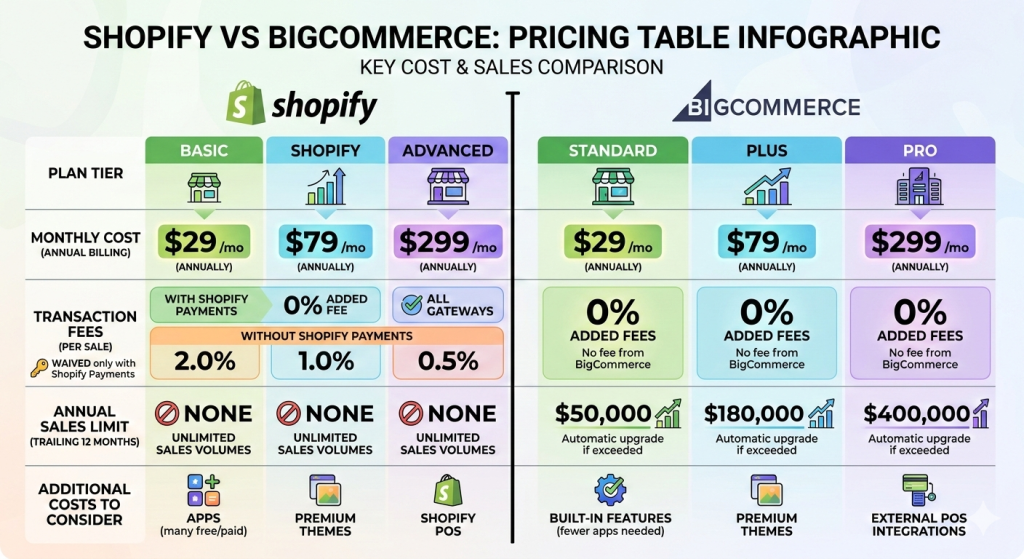
Infographic with monthly cost, transaction fees, and annual sales limits for both platforms clearly highlighted.
2. Ease of Use: Which Platform is Simpler to Manage?
If you ask most first-time store owners what they value most in a platform, ‘ease of use’ tops the list every time. The good news is that both Shopify and BigCommerce have made major usability improvements over the years but one clearly leads.
Shopify: The Gold Standard for Simplicity
Shopify has earned its reputation as the most beginner-friendly ecommerce platform on the market. Its drag-and-drop store editor is clean, logically organized, and guides new users through every step of the setup process. Experienced users have reported getting a functional store launched in under two hours.
The admin dashboard is consistently praised for its clarity. Whether you are managing inventory, processing orders, or launching a discount campaign, the workflow feels natural. You rarely need to dig through documentation to find a basic feature.
BigCommerce: Powerful, But More Complex
BigCommerce is not difficult to use, but it demands a bit more patience. The platform packs a larger number of native features, and that depth can make the interface feel busier. Tasks like setting up multi-currency pricing or configuring advanced shipping rules require more steps than their Shopify equivalents.
For store owners with some ecommerce experience or access to a developer, BigCommerce’s depth is actually an asset. For true beginners, there is a steeper initial learning curve.
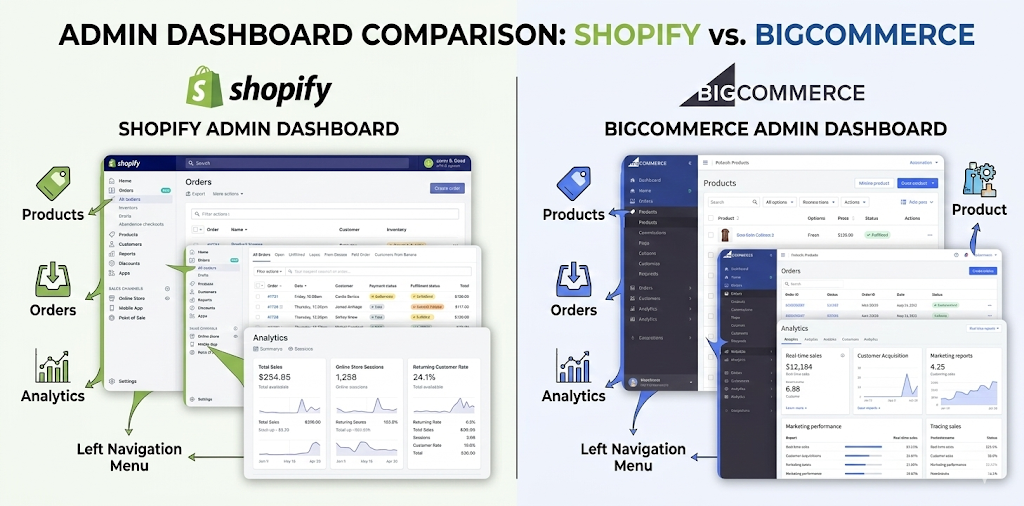
Comparison of Shopify vs BigCommerce admin dashboards. Label key sections like Products, Orders, and Analytics.
3. Themes & Design Flexibility of Shopify vs Bigcommerce
Your storefront is your brand’s first impression. A slow, outdated, or hard-to-navigate design can cost you conversions regardless of how great your products are.
Shopify Themes
Shopify’s theme marketplace offers over 100 professionally designed templates, with a selection of free options and premium themes ranging from $180 to $350. The themes are polished, mobile-responsive by default, and built with conversion best practices in mind. The drag-and-drop visual editor allows non-developers to customize layouts, fonts, and colors without touching any code.
For developers, Shopify’s Liquid templating language provides deep customization. The platform also integrates with tools like Canva and Figma for design-forward merchants.
BigCommerce Themes
BigCommerce offers roughly 200 themes through its Marketplace, including a collection of free templates. The designs are solid and functional, though many users find them less visually polished compared to Shopify’s curated selection. Premium themes range from $150 to $400.
BigCommerce recently introduced its Catalyst storefront framework, a performance-oriented headless option for developers building custom storefronts with React. This gives enterprise merchants exceptional design freedom, but it requires developer involvement.
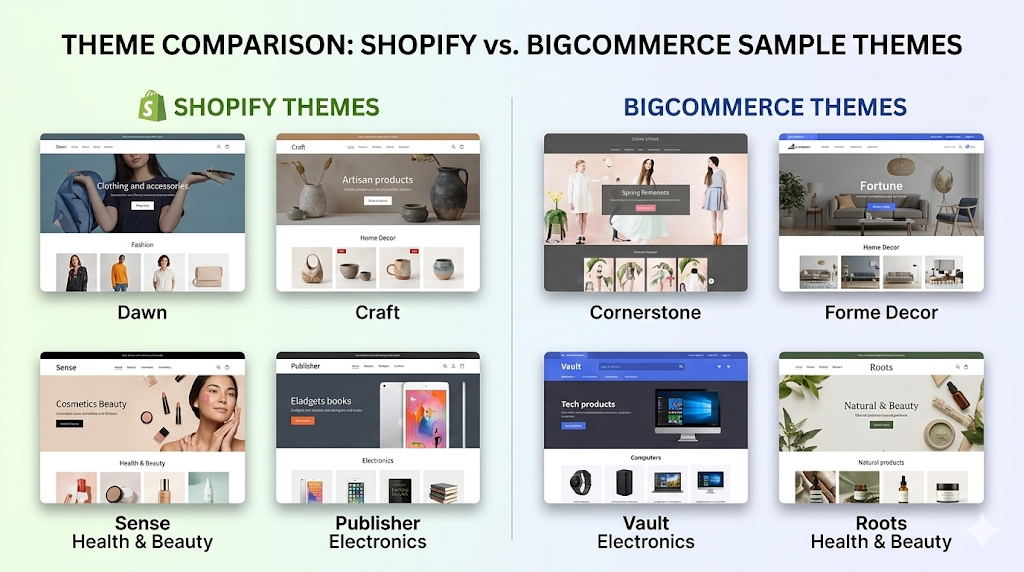
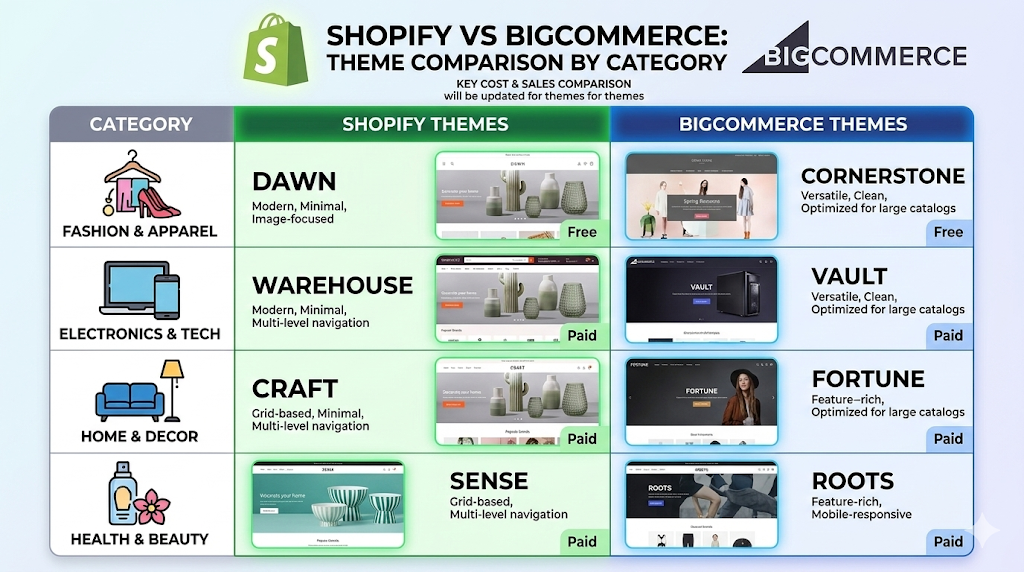
sample themes from each platform side by side. Caption them with their category (e.g., Fashion, Electronics, Home Decor).
4. Built-in Features vs App Ecosystem of Shopify vs Bigcommerce
This is arguably the most significant philosophical difference between the two platforms, and it will directly impact your monthly costs.
BigCommerce: Features First
BigCommerce is built around the idea that critical ecommerce capabilities should come included with your subscription. Features that often require paid Shopify apps, such as real-time shipping rate calculation, multi-currency support, bulk pricing rules, and product facets for search filtering are available natively in BigCommerce plans.
This means fewer monthly app subscriptions and less compatibility risk when platform updates roll out.
Shopify: The App Store Advantage
Shopify’s app store contains over 8,000 third-party applications covering virtually every ecommerce need imaginable: email marketing, loyalty programs, upsell tools, reviews, inventory management, and hundreds more. The scale of this ecosystem means there is almost always a tool for any problem you encounter.
The trade-off is that many essential features require paid apps. Running a mid-tier Shopify store with several apps installed can add $100 to $500 to your monthly overhead, a figure that should factor into your total cost calculation.
5. Payment Gateways & Transaction Fees of Shopify vs Bigcommerce
The payment infrastructure you choose affects not just your checkout experience but your bottom line every single month.
Shopify Payments & Third-Party Options
Shopify supports over 100 payment gateways worldwide and has developed its own first-party processor, Shopify Payments, which eliminates transaction fees entirely for eligible merchants. However, Shopify Payments is currently only available in select countries. Merchants who rely on third-party processors like PayPal, Stripe, or local gateways face fees ranging from 0.5% to 2% per transaction depending on their plan.
For high-volume stores, this adds up quickly. A store generating $500,000 in annual revenue on the Basic plan could pay $10,000 annually in transaction fees alone.
BigCommerce Payment Flexibility
BigCommerce connects with over 65 payment gateways and charges zero transaction fees across every plan, including Standard. This makes it especially attractive for international merchants, high-volume stores, and businesses operating in markets where Shopify Payments is unavailable.
Pre-integrated providers include PayPal, Stripe, Square, Amazon Pay, and many region-specific options.
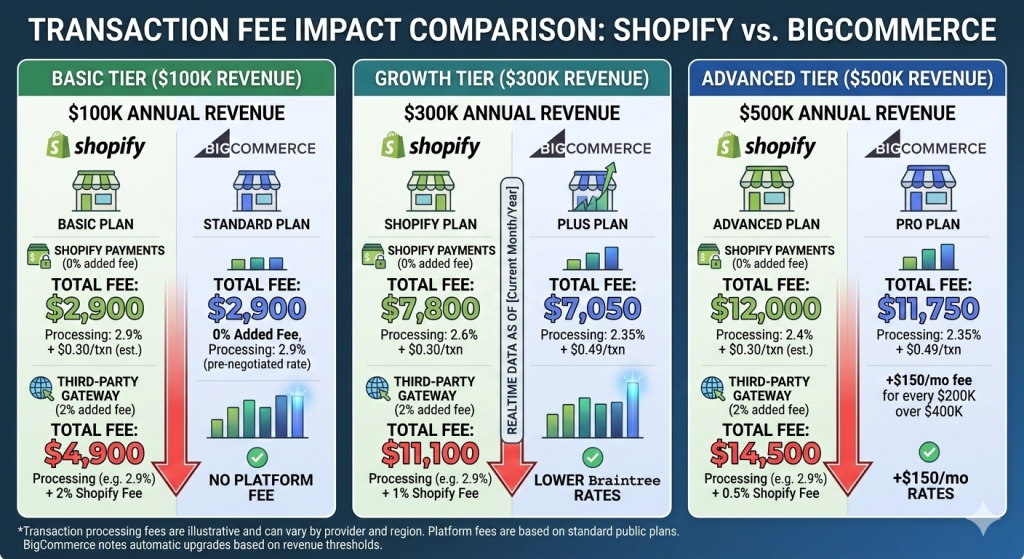
Infographic showing transaction fee impact at $100K, $300K, and $500K annual revenue on both platforms.
6. SEO & Marketing Capabilities of Shopify vs Bigcommerce
Organic traffic is free traffic. Your platform’s SEO architecture can be the difference between ranking on page one and being buried on page five.
BigCommerce SEO Strengths
BigCommerce is frequently cited as the stronger native SEO platform. Key advantages include full URL customization across all page types, bulk 301 redirect management, customizable faceted search for category pages, automatic microdata/schema markup, and precise control over canonical tags. These features give BigCommerce merchants more leverage over technical SEO without requiring additional plugins.
One practical example: Shopify forces all blog URLs to follow a fixed structure that cannot be modified. BigCommerce allows complete URL customization, which can be important for managing legacy content or building topically organized site architectures.
Shopify SEO Features
Shopify covers all the fundamentals — customizable meta titles and descriptions, auto-generated XML sitemaps, image alt text fields, and mobile-optimized pages. For many small and mid-sized stores, this is entirely sufficient. Advanced SEO requirements can be addressed through apps like SEO Manager or Smart SEO.
Shopify also integrates seamlessly with Google Merchant Center, Facebook Shops, and Instagram Shopping, making it powerful for paid and social commerce campaigns.
7. Scalability: Which Platform Grows With You?
Your needs as a startup are very different from your needs as a mid-market retailer, and both platforms have enterprise tiers but they scale differently.
Shopify Plus
Shopify Plus is designed for high-growth merchants and large enterprises. Starting at around $2,300–$2,500 per month, it unlocks features like custom checkout experiences using Shopify’s checkout extensibility tools, unlimited API integrations, dedicated merchant success managers, automation via Shopify Flow, and multi-store management across multiple geographic markets.
Brands like Gymshark, Allbirds, and Kylie Cosmetics have scaled their operations on Shopify Plus. Its global infrastructure handles flash sales and traffic spikes reliably.
BigCommerce Enterprise & B2B
BigCommerce Enterprise targets B2B merchants, wholesale brands, and complex multi-channel retailers. The platform offers native B2B Edition features including price lists per customer group, quote management, purchase order support, and corporate account structures all without requiring third-party apps.
BigCommerce also supports multi-storefront management natively, allowing merchants to run separate storefronts for different regions or customer segments from one centralized account.
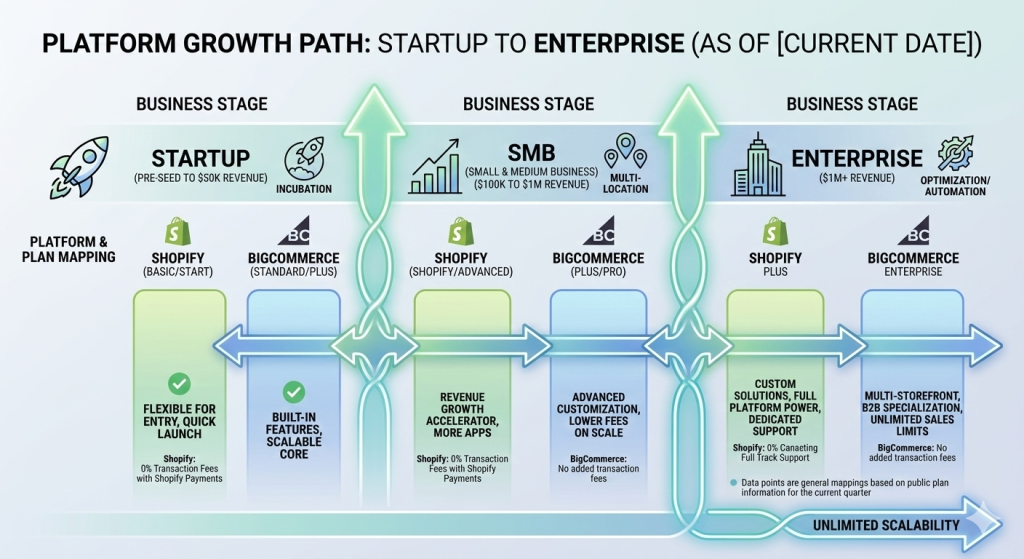
Showing business stages (Startup → SMB → Enterprise) mapped to the appropriate plan on each platform.
8. Customer Support & Resources of Shopify vs Bigcommerce
When something breaks at 11pm the night before a product launch, your support options become very important.
Shopify Support
Shopify offers 24/7 support through live chat, email, and phone. Notably, the platform also maintains an active social media support presence, meaning you can sometimes resolve issues quickly through Twitter or Facebook. The Shopify Help Center is extensive, and the Shopify Community forum has over a million members providing peer-to-peer assistance.
BigCommerce Support
BigCommerce provides 24/7 live chat, phone, and email support. Higher-tier plans include dedicated account managers and priority support queues. The BigCommerce Community and Help Center are comprehensive, though some users note the documentation can be less intuitively organized than Shopify’s.
Both platforms provide similar core support quality, but Shopify’s larger community ecosystem and social media presence give it a slight edge for accessibility.
9. Shopify vs BigCommerce: Who Should Use Which?
Choose Shopify If You:
- Are launching your first online store and want the fastest, easiest setup experience.
- Plan to use dropshipping apps like DSers, AutoDS, or Zendrop.
- I want access to the largest app marketplace in ecommerce.
- Will use Shopify Payments (available in your country) to avoid transaction fees.
- Prioritize a modern, visually polished storefront theme.
- Sell primarily through social channels like Instagram, TikTok Shop, or Facebook.
Choose BigCommerce If You:
- Run a high-volume store and want to eliminate transaction fees entirely.
- Operate in a country where Shopify Payments is unavailable.
- Sell to both B2B and B2C customers and need native wholesale features.
- Want advanced SEO control without relying on third-party plugins.
- Manage large, complex product catalogs with many variants.
- Are looking for more built-in features to reduce app subscription costs.
10. Final Feature-by-Feature Comparison of Shopify and Bigcommerce
| Category | Shopify | Bigcommerce |
|---|---|---|
| Price (entry) | $29/month | $29/month |
| Transaction Fees | 0.5%–2% (third-party) | None |
| Free Trial | 3 days | 15 days |
| Ease of Setup | ★★★★★ | ★★★★☆ |
| Themes Available | 100+ (premium: $180–$350) | 200+ (premium: $150–$400) |
| App Marketplace | 8,000+ apps | ~1,000 apps |
| Built-in Features | Moderate | Extensive |
| SEO Control | Good (URL limits) | Excellent (full control) |
| Payment Gateways | 100+ (fees apply) | 65+ (no fees) |
| B2B Features | Via apps | Native (B2B Edition) |
| Multi-storefront | Shopify Markets (Plus) | Native support |
| Headless Commerce | Hydrogen + Oxygen | Catalyst framework |
| Enterprise Plan | Shopify Plus ($2,300+/mo) | Enterprise (custom) |
| Best For | Beginners, DTC brands, dropshippers | B2B, high-volume, SEO-focused |
Conclusion: Making the Right Choice for Your Business
Both Shopify and BigCommerce are exceptional ecommerce platforms that have earned their reputations through years of development, innovation, and merchant success. Choosing between them is not about finding the ‘better’ platform in absolute terms, it is about finding the right fit for your specific situation.
Shopify wins on simplicity, design quality, app ecosystem diversity, and the sheer breadth of support resources available. It is the best starting point for new merchants and remains the top choice for direct-to-consumer brands, dropshippers, and social-first businesses.
BigCommerce wins on built-in feature richness, transaction fee elimination, SEO flexibility, and native B2B capabilities. It is the smarter choice for scaling merchants who want to avoid relentless app subscriptions, international sellers who cannot access Shopify Payments, and B2B operators who need wholesale tools out of the box.
Still unsure? Start with Shopify if you are a beginner or want a fast setup. Move to BigCommerce if you are hitting scaling costs, need B2B features, or want stronger native SEO control. Both platforms offer free trials, so you can test before you commit.
Frequently Asked Questions (FAQ)
Shopify is better for beginners, dropshippers, and direct-to-consumer brands. BigCommerce is better for B2B sellers, high-volume stores, and merchants who want more built-in features without relying on paid apps. Neither platform is universally superior; the best choice depends on your specific business model, budget, and growth goals.
The core difference is their business philosophy. Shopify is app-driven; it keeps its core simple and relies on a vast marketplace of 8,000+ third-party apps to extend functionality. BigCommerce is feature-driven; it bundles advanced capabilities like multi-currency, real-time shipping, and bulk pricing natively into every plan.
No. BigCommerce charges zero transaction fees on all plans, regardless of which payment gateway you use. This makes it particularly attractive for high-volume merchants and international sellers who cannot use Shopify Payments.
BigCommerce has stronger native SEO capabilities. It offers full URL customization, bulk 301 redirects, customizable faceted search, and automatic microdata markup all without needing plugins. Shopify covers the basics well but has URL structure limitations that cannot be changed, such as the fixed /blogs/ prefix.
Both platforms start at $29/month (billed annually), so the headline price is identical. BigCommerce tends to be cheaper in total cost of ownership because it charges no transaction fees and includes more features natively, reducing app spending. Shopify can become more expensive as you add apps and scale past basic plan limits.
Yes, but Shopify is generally the better choice for most small businesses due to its easier setup and more beginner-friendly interface. BigCommerce is more suited for small businesses with technical resources or those planning significant near-term growth into B2B, wholesale, or multi-channel selling.
Yes. Migrating between Shopify and BigCommerce is possible and relatively straightforward using third-party migration tools like LitExtension or Cart2Cart. These tools can transfer products, customer records, order history, categories, and reviews with minimal downtime.
BigCommerce is the clear winner for B2B ecommerce. Its native B2B Edition includes price lists per customer group, purchase order support, quote management, corporate account structures, and bulk order forms all without requiring expensive apps or upgrading to an enterprise tier
As of 2026, Shopify powers approximately 5.8 million active stores worldwide and holds roughly 25–30% of the global SaaS ecommerce market. BigCommerce hosts around 41,000 active stores and accounts for approximately 3–5% of the market. Shopify’s larger user base translates to a bigger community, more third-party integrations, and a more mature app ecosystem.
Both platforms offer free trials. BigCommerce provides a 15-day free trial with no credit card required. Shopify offers a 3-day free trial, often followed by a promotional offer of $1/month for the first 3 months, which effectively gives new users up to 90 days at minimal cost.

