

Supply Chain Network in 2026; Design, Steps, Types, Optimization.
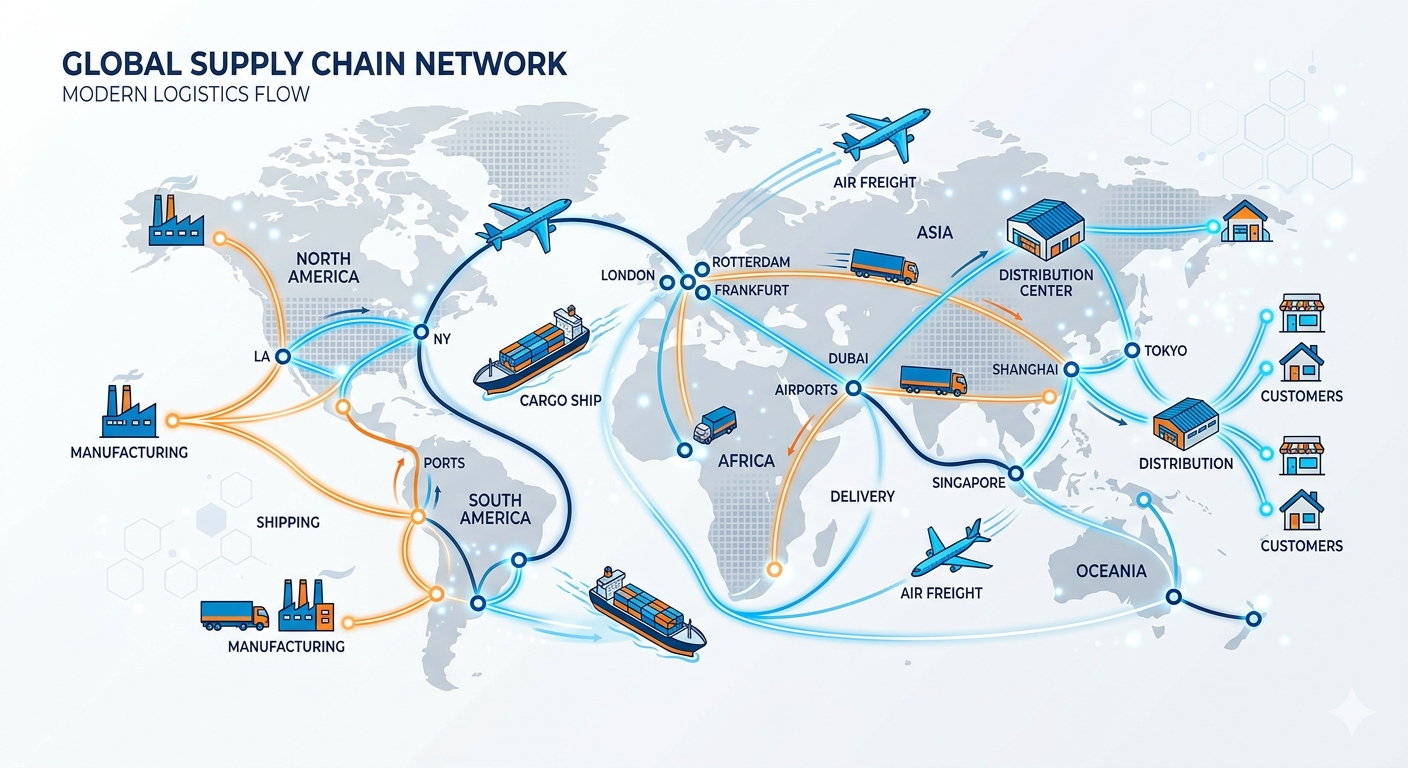
Introduction: Why Your Supply Chain Network Is Your Business Backbone
Every time a product moves from a factory floor to a customer’s doorstep, it travels through an invisible web of decisions, infrastructure, and relationships. That web is your supply chain network, and the way it is designed can either accelerate your business growth or quietly erode your margins quarter by quarter.
In 2024, global supply chain disruptions cost businesses an estimated $1.6 trillion in lost revenue. Yet companies with optimized, resilient supply chain networks weathered these storms with 30 to 50 percent less operational impact. The difference was not luck. It was architecture.
This guide goes beyond the surface-level definitions you will find elsewhere. We walk through what a supply chain network really is, why the design decisions you make today determine your competitive position tomorrow, how to optimize every node in the network, and what the next generation of AI-powered, sustainable supply chains will look like. Whether you are a supply chain manager rethinking your distribution footprint, a business leader evaluating technology investments, or a logistics professional seeking to sharpen your knowledge, this is the guide you have been looking for.
A supply chain network is not just a logistical infrastructure. It is a strategic asset. Companies that treat it as such consistently outperform those that do not.
What Is a Supply Chain Network? Definition and Core Concepts
A supply chain network is the interconnected system of organizations, facilities, transportation links, information flows, and financial relationships that together enable goods to move from raw material sources to end consumers. Unlike a simple supply chain, which implies a linear sequence, a network acknowledges the multi-directional, multi-tiered reality of how modern commerce actually operates.
Think of it like a city’s road system. There are highways serving as primary distribution routes, arterial roads acting as regional distribution corridors, and local streets enabling last-mile delivery. Each layer serves a distinct purpose, and the efficiency of the whole depends entirely on how well the layers connect with one another.
The Five Core Elements of a Supply Chain Network
1. Suppliers and Raw Material Sources: The origin points where materials, components, or finished goods are procured. A company may have first-tier suppliers who themselves source from second and third-tier suppliers, creating a deep and complex upstream network that requires active management.
2. Manufacturing and Production Facilities: Plants and factories where raw materials are transformed into finished or semi-finished products. Location, capacity, and flexibility of these facilities are critical design variables that shape the entire downstream network.
3. Distribution Centers and Warehouses: The storage and sorting hubs that buffer inventory between production and consumption. Their geographic placement directly determines delivery speed, transportation cost, and the overall responsiveness of the network.
4. Transportation Links: The physical and logical connections between nodes including road, rail, sea, and air freight, alongside the carriers, routes, and contracts that govern how goods flow through them.
5. Customers and End Markets: The demand endpoints that the entire network exists to serve. Customer geography, service expectations, and order behavior shape every upstream decision in the network.
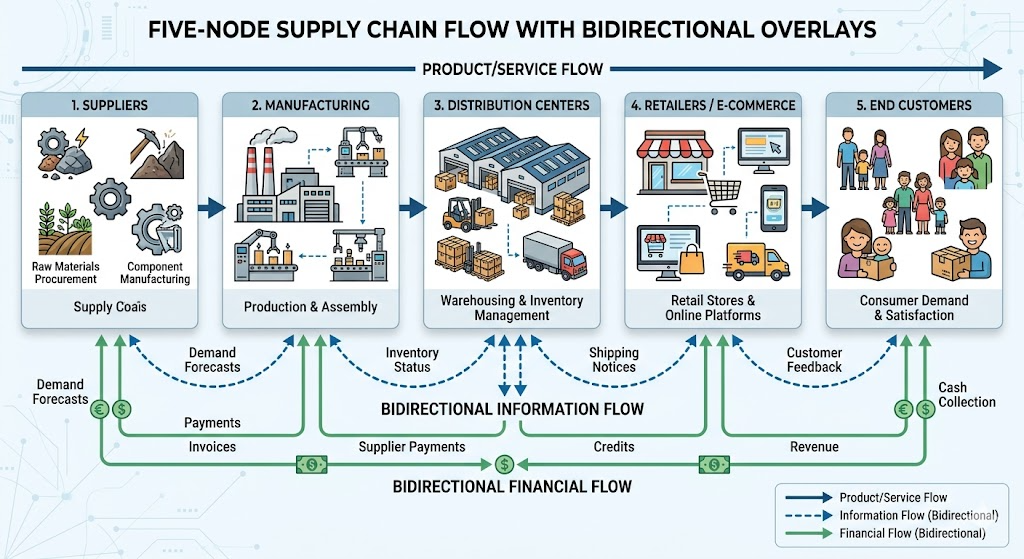
Five-node supply chain network flow — Suppliers to Manufacturing to Distribution Centers to Retailers/E-commerce to End Customers, with bidirectional information and financial flows overlaid.
Supply Chain Network vs. Supply Chain: What Is the Difference?
Many professionals use these terms interchangeably, but they are meaningfully distinct. A supply chain is a sequential process where raw materials become products and move to customers. A supply chain network is a complex system with multiple suppliers feeding multiple plants, serving multiple distribution centers that reach multiple customer segments, often across multiple countries simultaneously. Networks are characterized by feedback loops, redundancy, interdependencies, and the need for dynamic optimization across the whole system, not just individual links.
Types of Supply Chain Networks: Which Model Fits Your Business?
There is no universal supply chain network structure. The right design depends on your industry, product characteristics, customer expectations, and strategic priorities. Here are the primary models and when each works best.
1. Centralized Supply Chain Network
In a centralized model, a single distribution hub or a small cluster of facilities serves the entire market. All inventory is pooled in one location and shipped outward to customers or regional partners as orders arise.
Best for: Companies with high-value, low-volume products; businesses with predictable, geographically clustered demand; and organizations where inventory pooling benefits outweigh shipping cost increases.
Advantages: Lower inventory carrying costs due to pooling effects, simpler management, stronger purchasing power, and greater control over quality and consistency.
Risks: Single points of failure, longer delivery times to distant customers, and significant vulnerability to regional disruptions.
2. Decentralized Supply Chain Network
Decentralized networks distribute inventory and facilities closer to customer demand points. Multiple regional warehouses or distribution centers operate in parallel to serve nearby markets with speed and responsiveness.
Best for: E-commerce companies, retailers, and any business where delivery speed is a primary competitive differentiator.
Advantages: Faster last-mile delivery, greater resilience through distributed risk, and strong localized responsiveness to market shifts.
Risks: Higher inventory duplication, more complex management across multiple sites, and increased fixed infrastructure costs.
3. Hub-and-Spoke Network
The hub-and-spoke model routes goods through central hubs before distributing them to local spoke facilities. Airlines pioneered this design, but it is now widely used in parcel delivery, retail distribution, and food service logistics.
Best for: Parcel carriers, multi-product businesses, and companies serving broad geographies with diverse SKU portfolios that require efficient sortation.
Advantages: High transportation utilization efficiency, strong scalability, and excellent sortation and cross-docking capabilities.
Risks: Hub congestion can cascade across the entire network; not ideal for time-critical or highly perishable deliveries.
4. Flexible and Hybrid Network
Modern businesses increasingly operate hybrid networks that blend centralized efficiency with decentralized responsiveness. Strategic inventory is held centrally for long-tail or slow-moving SKUs, while fast-moving products are positioned locally. The network flexes based on real-time demand signals and seasonal patterns.
Best for: Omnichannel retailers, consumer goods companies, and businesses with highly variable or seasonal demand patterns.
5. Collaborative and Shared Network
Collaborative networks allow multiple companies, sometimes direct competitors, to share logistics infrastructure such as warehouses, transportation lanes, and supplier relationships. This model is gaining significant traction as sustainability pressures and cost optimization objectives converge.
Best for: Small and medium enterprises with insufficient volume to fill private logistics assets, companies reducing carbon footprints, and businesses operating in low-density or emerging markets.
Supply Chain Network Design: The Strategic Blueprint
Supply chain network design (SCND) is the process of defining the optimal physical and operational configuration of your network to meet business objectives at the lowest total cost. It is arguably the highest-leverage decision in supply chain management, because every other operational decision, including inventory levels, transportation contracts, and service commitments, flows directly from the network architecture chosen.
Most published guides treat network design as a static, one-time exercise. In reality, it is a living process that must be revisited as markets shift, customer expectations evolve, and new capabilities emerge. The leading organizations in supply chain management revisit their network configurations at least annually and make targeted adjustments in response to significant market changes.
Phase 1: Strategic Assessment and Data Foundation
Exceptional network design begins with exceptional data. Before drawing a single node on a map, you need a comprehensive picture of current performance and future demand trajectory.
- Demand mapping: Where are your customers today, and where will they be in three to five years? Segment by geography, channel, and product category to reveal the true shape of demand.
- Cost-to-serve analysis: What does it actually cost to serve each customer segment, including all transportation, warehousing, inventory carrying costs, order management, and returns handling?
- Supplier landscape: Where are your suppliers concentrated? What are the lead times, minimum order quantities, and risk profiles of each source relationship?
- Service level baseline: What delivery promises are you currently making? What promises will you need to make to win and retain customers over the planning horizon?
- Existing asset inventory: What facilities, transportation contracts, and technology platforms do you currently operate, and what are their constraints, costs, and remaining useful lives?
Data quality is the most common failure point in supply chain network design projects. Without reliable data on costs, demand, and service performance, even the most sophisticated optimization model will produce misleading results that lead to expensive infrastructure decisions.
Phase 2: Network Modeling and Scenario Analysis
With data in hand, the next step is building a model that represents your current network and allows you to test alternative configurations rigorously. Modern supply chain network modeling tools allow planners to simultaneously evaluate thousands of network configurations against cost, service, and risk criteria in hours rather than weeks.
Key scenarios every organization should model include:
- Baseline: Current network performance projected under future demand growth.
- Consolidation: Fewer, larger facilities to test whether scale efficiency outweighs service level degradation.
- Expansion: Additional network nodes to serve growth markets, with optimization of placement.
- Risk stress tests: Network performance if a critical supplier fails, a key distribution center is disrupted, or a major transportation lane becomes unavailable.
- Sustainability scenarios: Carbon footprint and total cost across different modal and facility configurations.
Phase 3: Optimization and Trade-off Resolution
Supply chain network optimization is the mathematical process of finding the network configuration that best satisfies your defined objectives, typically minimizing total landed cost while maintaining target service levels and managing identified risks. This is where the real strategic thinking is required, because optimization always surfaces trade-offs that must be resolved through explicit business judgment.
The classic trade-off triangle in supply chain network design involves cost, speed, and resilience. Understanding this helps leaders make better-informed decisions:
| Trade-off | Optimizing For | What You Sacrifice | Typical Context |
|---|---|---|---|
| Cost vs. Speed | Lowest transportation cost | Delivery speed through fewer, more distant facilities | Commodity products, price-sensitive markets |
| Speed vs. Resilience | Fastest possible delivery | Redundancy through lean inventory and concentrated sourcing | E-commerce, fast fashion, FMCG |
| Resilience vs. Cost | Maximum supply chain redundancy | Cost efficiency through duplicate inventory and multiple sources | Pharma, defense, critical food supply |
| All Three Balanced | Hybrid optimization model | None fully maximized, but all adequately served | Consumer goods, retail, technology products |
Phase 4: Implementation Roadmap
A supply chain network redesign is rarely implemented overnight. The best programs phase changes to manage risk, validate real-world assumptions, and build organizational capability alongside physical infrastructure changes.
- Quick wins first: Optimize inventory positioning and carrier contracts within the current footprint before committing capital to facility changes.
- Pilot before scaling: Test new distribution center locations or transportation modes in a limited geography before rolling out across the full network.
- Build for flexibility: Design new facilities and contracts with optionality built in, so you can scale up, scale down, or pivot as market conditions change.
- Technology enablement: Ensure your TMS, WMS, and planning systems are configured to support the new network design from the first day of operation.
Key Factors That Shape Supply Chain Network Design Decisions
Supply chain network design decisions are never made in a vacuum. Every choice is shaped by a constellation of internal capabilities and external market forces that must be carefully understood and weighed against one another.
Customer Geography and Service Level Requirements
The location and density of your customer base is the single most powerful driver of network configuration. A company serving customers uniformly distributed across a continent needs a fundamentally different network than one serving a concentrated urban market. Service level commitments, such as same-day, next-day, or 48-hour delivery, directly translate into required proximity of inventory to customers, which in turn drives facility count and geographic placement decisions.
A practical rule of thumb: for every tier of delivery speed improvement you commit to, you roughly double the number of stocking locations needed. Moving from 48-hour to next-day delivery typically means moving from three to five regional distribution centers to ten to twenty local fulfillment nodes in a national market.
Transportation Infrastructure and Carrier Ecosystem
The quality, cost, and reliability of transportation infrastructure in your markets fundamentally constrains what is achievable in network design. Key considerations include multimodal availability and flexibility, carrier capacity and reliability in tight freight markets, customs and border complexity for international networks, and the density and capability of the last-mile delivery ecosystem in your key urban markets.
Inventory Economics and Working Capital
One of the most underappreciated factors in network design is the relationship between network footprint and total inventory investment. Adding distribution centers reduces transportation costs and improves delivery speed, but it also fragments inventory across more locations, which increases the total safety stock required to maintain a given service level.
The square root rule of inventory states that if you increase stocking locations from N to M, total safety stock increases by the factor of the square root of M divided by N. Moving from 4 warehouses to 16 requires approximately twice the safety stock to maintain equivalent fill rates. This inventory cost must be included in every network expansion business case.
This means network design and inventory strategy must be co-optimized together. Adding a fifth distribution center might reduce transportation cost by two million dollars annually but increase inventory carrying cost by three million. That is a net negative that only shows up when both dimensions are modeled simultaneously.
Regulatory, Tax, and Geopolitical Environment
Where you locate facilities determines the regulatory and tax environment you operate within. This encompasses corporate tax rates and treaty structures, free trade zone benefits, import and export licensing requirements, labor law flexibility for logistics operations, and environmental compliance obligations. For global supply chains, geopolitical risk has risen sharply as a design variable, with significant consequences for facility placement and sourcing strategy.
Sustainability and Carbon Footprint
Sustainability has moved from a compliance checkbox to a genuine network design variable with financial consequences. Regulatory frameworks in the EU, UK, and increasingly in Asian markets require companies to measure, report, and reduce supply chain emissions. Network-level sustainability decisions include transportation mode optimization, facility energy footprint and sourcing, network consolidation to reduce total delivery miles, and reverse logistics integration for product recovery and recycling.
Not sure if your supply chain is profitable?
Supply Chain Network Optimization: Turning Design into Performance
Design creates the structure; optimization extracts the performance. Supply chain network optimization is the ongoing process of tuning the network, including inventory levels, routing decisions, carrier selection, and facility throughput, to maximize efficiency and service delivery within the designed footprint. It is continuous rather than periodic.
Demand-Driven Optimization
Traditional supply chains were push-based: factories produced to forecast, and inventory was pushed down the network. Modern optimization inverts this model. Real-time demand signals from point-of-sale systems, e-commerce platforms, and customer order data pull inventory through the network dynamically, reducing excess stock and improving fill rates simultaneously.
- Real-time demand sensing: Aggregating signals from all customer touchpoints to detect demand shifts before they translate into forecast errors and inventory mismatches.
- Dynamic replenishment: Adjusting stocking decisions at individual nodes based on current demand patterns rather than historical averages that may no longer reflect market reality.
- Omnichannel inventory visibility: Knowing the location of every unit across the entire network, including stores, distribution centers, and in-transit inventory, enables far smarter allocation decisions.
Transportation Network Optimization
Transportation is typically the largest variable cost in a supply chain network. Optimizing it requires decisions at three distinct levels: strategic (which modes, lanes, and carriers to use), tactical (how to consolidate shipments and build efficient loads), and operational (dynamic route adjustment based on real-time conditions). Modern Transportation Management Systems integrate all three levels, with AI increasingly automating tactical and operational decisions.
Inventory Optimization Across the Network
Getting inventory right, the right product in the right quantity at the right node, is the central challenge of supply chain network optimization. Three key approaches drive superior performance:
- Multi-echelon inventory optimization (MEIO): Rather than optimizing inventory at each node independently, MEIO balances inventory investments across the entire network to minimize total cost at a given service level target.
- Safety stock optimization: Using statistical demand variability and lead time data to set safety stock levels at each node scientifically rather than through rules of thumb or historical convention.
- Postponement strategies: Delaying product differentiation such as packaging, configuration, or localization to as late a point in the network as possible, reducing the risk of holding incorrectly positioned inventory.
Technology Enablers of Supply Chain Network Optimization
| Technology | Application in Network Optimization | Adoption Status |
|---|---|---|
| AI and Machine Learning | Demand forecasting, anomaly detection, route optimization, supplier risk prediction | High, widely deployed across sectors |
| Digital Twin | Real-time network simulation and scenario testing against live operational data | Growing early majority adoption |
| IoT and Real-Time Tracking | Live inventory visibility, shipment condition monitoring, predictive maintenance | High mainstream across logistics |
| Blockchain | Supplier verification, traceability, automated payments, compliance documentation | Moderate sector-specific deployment |
| Cloud-Native Planning Platforms | Integrated planning across design, inventory, transportation, and demand management | High rapidly replacing legacy systems |
| Generative AI | Scenario generation, supply chain analytics, exception management, reporting | Emerging early adopter phase |
Building Supply Chain Network Resilience: Beyond Risk Management
The COVID-19 pandemic, the Suez Canal blockage, global semiconductor shortages, and escalating geopolitical tensions have collectively proved a single uncomfortable truth: supply chain networks designed purely for cost efficiency are brittle. Resilience must be engineered into the network architecture, not bolted on as an afterthought during a crisis.
But resilience is not simply about adding redundancy everywhere. That approach would be prohibitively expensive and operationally complex. True resilience is about strategic redundancy: identifying the nodes and flows where disruption would be most costly and investing in optionality at precisely those critical points.
The Four Dimensions of Supply Chain Resilience
1. Redundancy: Having viable backup options for critical suppliers, transportation lanes, and production capacity. Not every node requires a backup, but your most critical single points of failure absolutely do.
2. Flexibility: The ability to shift sourcing, production, or distribution routing quickly when disruption strikes. Flexible supplier contracts, multi-sourcing strategies, and dual-mode transportation agreements all contribute meaningfully.
3. Visibility: You cannot respond to what you cannot see. End-to-end visibility across the supply chain, from Tier 2 and 3 suppliers through to final delivery, is the foundational capability of a resilient supply chain network.
4. Velocity: How quickly can your organization detect a disruption, make a decision, and execute a response? This is as much an organizational and process capability as it is a technology challenge.
Practical Resilience Strategies for Supply Chain Networks
- Dual and multi-sourcing: Qualify at least two suppliers for every critical component or material category. The cost premium of multi-sourcing is insurance against supply failure.
- Geographic diversification: Avoid concentrating manufacturing or distribution capacity in a single country or region. Regional manufacturing hubs reduce exposure to geopolitical disruption and logistics volatility.
- Strategic inventory buffers: Not at every node, but at points where lead times are long, demand is volatile, or supplier alternatives are limited, strategic buffer stock provides valuable insurance.
- Supply chain control tower: A centralized visibility and decision-support platform that aggregates data from across the network and enables rapid, coordinated response to disruptions.
- Contractual flexibility: Build volume flexibility clauses into supplier and carrier contracts. The right to scale volume up or down without penalty is worth the small premium it commands.
Resilience is not about eliminating supply chain risk. It is about ensuring that when disruption occurs, and it will, your supply chain network can absorb the shock, adapt quickly, and recover faster than your competitors can.
Supply Chain Network Design Best Practices: What Market Leaders Do Differently
After examining numerous network design projects across industries globally, several practices consistently separate high-performing supply chain networks from average ones. These are not theoretical principles but observable patterns in organizations that consistently outperform their peers.
1. Start with the Customer, Not the Cost
The most common mistake in supply chain network design is starting with cost reduction as the primary objective. Leading organizations start with the customer service proposition: what promises must we make to win, retain, and grow our customer relationships? They then design the most cost-efficient network capable of delivering those promises reliably. Cost optimization within a customer-defined service envelope almost always outperforms pure cost minimization without that service anchor.
2. Model Total Cost, Not Unit Cost
Transportation rates and warehouse lease costs are visible and easy to compare. Inventory carrying costs, lost sales from stockouts, cost-to-serve variations across customer segments, and the hidden costs of network complexity are far less visible but often substantially larger in aggregate. Best-in-class network designers build total landed cost models that capture all relevant cost components and then optimize the total system cost, not individual line items.
3. Design for the Network You Will Need, Not the One You Have
Supply chain networks are long-lived capital assets. Major facility leases run 10 to 25 years. Significant transportation contracts span 3 to 5 years. The network you design today must serve the market you will operate in 3 to 5 years from now, not the market of today. Build demand evolution, channel shift (particularly e-commerce growth), and competitive dynamics into your baseline planning assumptions from the outset.
4. Integrate Sustainability from Day One
Retrofit sustainability is expensive and frequently ineffective. Organizations that integrate carbon and sustainability metrics into the network design process from the beginning, alongside cost and service level, consistently achieve better environmental and financial outcomes than those that add sustainability as an afterthought to an already-optimized cost design.
5. Build for Change, Not for Perfection
The optimal network configuration designed today will be suboptimal within 18 to 24 months as market conditions evolve. Design for adaptability rather than perfection: modular facility designs, flexible lease structures, technology platforms that can integrate new data sources, and organizational processes that support regular network reviews. The most resilient supply chains are those built to change, not those built to last unchanged.
6. Treat Network Design as a Cross-Functional Exercise
Supply chain network design decisions affect finance teams (capital allocation and working capital), commercial teams (service promises and market expansion), procurement (supplier selection and geography), and operations. Organizations that include all relevant stakeholders in the design process produce better-quality decisions and face significantly fewer implementation obstacles than those that treat network design as a purely technical supply chain function.
[VISUAL] Six-panel best practices tile layout: Each practice as a numbered card with an icon and a three-sentence summary. Use blue icons with white card backgrounds for a clean, professional visual.
The Future of Supply Chain Networks: Trends Shaping the Next Decade
The supply chain network of 2030 will look fundamentally different from the one that existed in 2020. Several powerful forces are converging to reshape network architecture, operating models, and the technology stack that makes it all function.
AI-Powered Autonomous Supply Chains
Artificial intelligence is moving from decision support to decision automation in supply chain management. Early applications in demand forecasting and route optimization are giving way to broader autonomous capabilities including self-adjusting inventory policies, AI-negotiated carrier contracts, and dynamic network reconfiguration in response to real-time disruption signals. The supply chain network of the future will increasingly be a self-optimizing system that continuously adapts to demand shifts, supply constraints, and external disruptions with minimal human intervention on routine decisions.
Nearshoring and Regional Network Restructuring
Decades of globalization pursued the lowest-cost production location, often at the expense of resilience and supply chain lead times. Geopolitical tensions, rising labor costs in traditional low-cost manufacturing countries, and hard-learned resilience lessons from recent disruptions are driving a significant structural shift toward regional supply chain models. Manufacturing is moving closer to consumption markets, with nearshoring in Mexico for US demand, Eastern Europe for Western European markets, and Southeast Asia serving regional Asian consumption.
Sustainability as a Core Network Design Variable
Regulatory pressure, particularly the EU Carbon Border Adjustment Mechanism, extended producer responsibility legislation, and mandatory scope 3 emissions reporting requirements, is making carbon a real financial cost that must be incorporated into network design models. Companies that proactively optimize their networks for lower emissions will carry a meaningful competitive advantage as these regulatory costs materialize across global markets.
Digital Twins of the Supply Chain
A digital twin is a real-time virtual replica of your physical supply chain network, continuously fed by IoT sensor data, transactional systems, and external market signals. It allows supply chain teams to monitor the current state of the network with full visibility, simulate the impact of potential decisions before committing to them, and run continuous optimization against live conditions. Early adopters are reporting cost reductions of 10 to 20 percent and significantly improved response times to network disruptions.
The Rise of Supply Chain as a Service
A growing ecosystem of third-party logistics providers, platform businesses, and shared infrastructure operators is making it possible to access world-class supply chain network capabilities without the capital burden of ownership. This particularly enables smaller and mid-sized businesses to compete with the supply chain capabilities of larger enterprises, democratizing access to sophisticated logistics infrastructure and optimization technology.
Circular Economy and Reverse Logistics Networks
Regulatory requirements for product take-back, rising raw material costs, and consumer demand for sustainable products are elevating reverse logistics from an operational afterthought to a network design priority. Forward and reverse supply chain networks are increasingly being co-designed so that the same facilities, transportation lanes, and technology platforms that move products forward can efficiently support the recovery, refurbishment, and recycling of returned goods.
[VISUAL] Timeline infographic: The evolution of supply chain networks from 1980s linear chains through 2000s global networks, 2010s digital supply chains, 2020s resilient networks, to 2030s autonomous AI-optimized systems.
Measuring Supply Chain Network Performance: The KPIs That Matter
You cannot manage what you do not measure. Effective supply chain network management requires a disciplined set of metrics that span cost efficiency, service delivery, inventory health, resilience, and sustainability. The most sophisticated organizations track these metrics at the network level, not just at individual facility or lane level.
| KPI Category | Key Metrics | Why It Matters |
|---|---|---|
| Cost Efficiency | Total cost to serve, transportation cost per unit, warehousing cost as percentage of revenue | Reveals true profitability by customer segment and identifies network optimization opportunities |
| Service Performance | On-time-in-full (OTIF) rate, perfect order rate, customer fill rate | Measures whether the network is reliably delivering on its customer service promise |
| Inventory Health | Inventory turns, days of supply, excess and obsolete inventory percentage | Indicates working capital efficiency and the quality of demand-supply alignment across nodes |
| Resilience | Supplier concentration risk score, network disruption mean recovery time | Tracks vulnerability to disruption and organizational speed of recovery |
| Sustainability | Supply chain carbon intensity per unit shipped, percentage renewable energy in facilities | Measures environmental performance against regulatory requirements and stakeholder expectations |
| Operational Efficiency | Warehouse throughput, transportation capacity utilization, dock-to-stock cycle time | Identifies operational bottlenecks and asset utilization gaps across the network |
Conclusion: Building a Supply Chain Network That Wins
A supply chain network is not a static infrastructure investment made once and forgotten. It is a dynamic competitive asset that requires continuous design, optimization, and adaptation as markets evolve, customer expectations shift, and new capabilities emerge. The companies that will win in the next decade are not necessarily those with the most facilities or the largest logistics budgets. They are those with the most intelligently designed, continuously optimized, and genuinely resilient supply chain networks.
The principles to carry forward from this guide:
- Design from the customer backwards: Let service commitments define the network configuration, then optimize cost efficiency within that service envelope.
- Model the total system: Cost, service, inventory, sustainability, and risk must all be captured in the model, not just transportation rates and warehouse lease costs.
- Build for resilience and adaptability: The next supply chain disruption is always coming. The question is whether your network will absorb it or amplify it.
- Invest in visibility and enabling technology: You cannot optimize what you cannot see, and you cannot see what your technology platforms do not connect and synthesize.
- Make network design a living process: Review your network configuration at minimum annually, and more frequently during periods of market volatility.
- Embed sustainability from the outset: Carbon and environmental performance are becoming financial metrics with regulatory and commercial consequences. Optimize for them proactively.
The supply chain network that wins tomorrow is being designed and optimized today. The decisions you make now about facility footprint, supplier relationships, technology investments, and resilience strategy will define your competitive position for the next five to ten years. Make them deliberately, with full visibility of the trade-offs involved.

