

Private Labeling & Profitable private label Products.
Introduction:
Private labeling has evolved from a retail-only strategy into one of the most powerful ways to build a scalable online business in 2026. Today, entrepreneurs, Amazon FBA sellers, and ecommerce brands are no longer limited to reselling generic products. Instead, they are creating private label brands owning the product identity, customer relationship, and long-term brand value.
At its core, private labeling allows you to sell products manufactured by third-party suppliers most commonly in China under your own brand name. You control the formulation, packaging, positioning, and pricing, while leveraging global manufacturing to keep costs low and margins high. This model has become especially popular in categories like private label skincare, private label hair care products, supplement private label, pet supplies, and fitness products, where branding and trust matter more than price alone.
What makes private labeling so attractive today is the infrastructure that supports it. Platforms like Amazon FBA, Shopify, and global logistics networks have removed many of the traditional barriers to entry. Even first-time sellers can now source products, customize them, and sell globally without owning warehouses or factories. At the same time, China’s manufacturing ecosystem has matured—offering not just mass production, but also low-MOQ customization, compliant formulations, and premium packaging options.
However, success in private labeling is no longer about picking any product and adding a logo. Competition is higher, advertising costs are rising, and consumers are more informed than ever. The brands that win are those that focus on micro niches, solve specific problems, and execute professionally—especially when it comes to sourcing, quality control, and compliance.
This guide breaks down everything you need to know about private labeling in 2026:
- What private labeling really is (and how it differs from white label and dropshipping)
- The history and evolution of private label brands
- Proven private label case studies with real-world numbers
- The most profitable private label product categories and micro niches
- How China sourcing works—and why a sourcing agent can make or break your brand
- A step-by-step execution framework to launch, scale, and protect your business
Whether you’re an Amazon FBA beginner, an experienced online seller, or someone looking to build a real brand asset—not just short-term sales—this article will give you a clear, practical roadmap.
Difference: Private Label vs White Label vs Drop shipping
Private Label
Private label means full customization — you own the design, branding, and often the product specifications. It’s ideal for private label skin care manufacturers, private label supplement manufacturers, and Amazon private label sellers who want to build a brand for the long term.
White Label
White label products are made in bulk, often with one universal design, and sold to many businesses. Each seller places their own label on the same basic product. This is common for white label skincare, white label cosmetics, white label website templates, or digital services like white label marketing agency tools.
Drop shipping
Drop shipping doesn’t require inventory — you sell products and a supplier ships them directly to your customer. Drop shipping is often used before scaling into private label because it minimizes upfront cost and helps you validate demand.
Key takeaway:
- Private labeling → brand ownership + customization.
- White labeling → re brandable generic products.
- Drop shipping → inventory-free model.
Understanding these differences is critical before entering private labeling, as the level of control, risk, and long-term brand value varies significantly between each model.
History of Private Labeling: From Store Brands to Amazon FBA
Early Origins of Private Labeling
Private labeling is not a modern invention—it has existed for more than a century. In the late 1800s and early 1900s, department stores and clothing retailers began selling goods under their own names instead of relying solely on national manufacturers. These early private label products allowed retailers to control pricing, ensure consistent quality, and improve profit margins. Apparel and packaged foods were among the first categories to adopt this approach, laying the foundation for today’s private label brands.
Globalization and China’s Role in Private Label Manufacturing
The modern private labeling boom began in the 1990s with globalization and the rise of China as a manufacturing powerhouse. Chinese factories offered unmatched advantages: cost efficiency, high-volume production, rapid turnaround times, and growing customization capabilities. This made it possible for businesses of all sizes to create private label products across categories such as private label skin care, private label hair care products, supplements, clothing, pet supplies, and home goods.
As manufacturers evolved, they began offering end-to-end private label solutions product formulation, packaging design, labeling, and compliance—dramatically lowering the barrier to entry. Today, most Amazon private label and Shopify-based brands rely on China sourcing agents to manage supplier vetting, quality control, and logistics.
The E-Commerce Era and Amazon Private Label
The launch of Amazon FBA (Fulfillment by Amazon) transformed private labeling into one of the most popular online business models. Sellers no longer needed warehouses or retail stores. Instead, they could source products, brand them, and let Amazon handle storage, shipping, and customer service.
Amazon itself embraced the model by launching Amazon Basics in 2009, proving that private label strategies work not only for retailers but also for digital-first platforms. Today, thousands of entrepreneurs build scalable online businesses using private labeling combined with Amazon FBA and SEO-driven product listings.
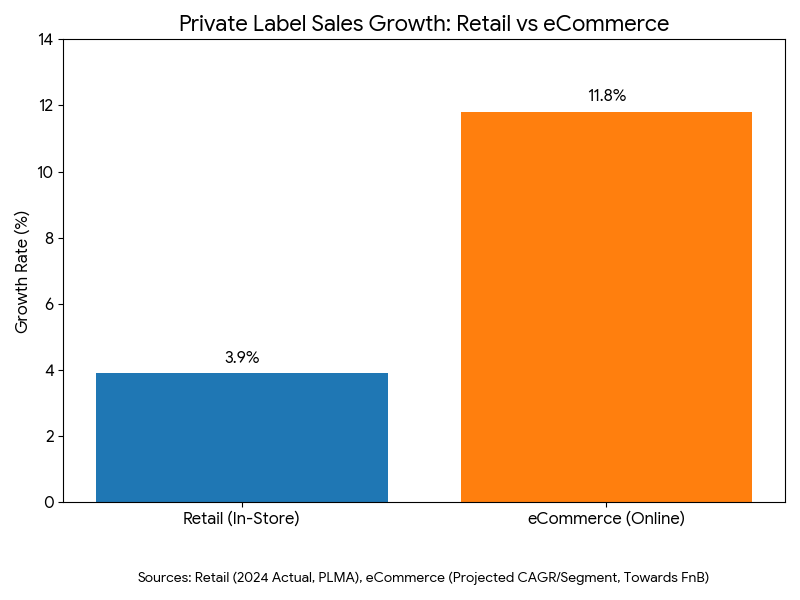
Private label growth across retail vs eCommerce
| Era | Key Development | Impact on Private Label |
| 1800s–Early 1900s | Store-branded clothing & food in department stores | Early private label foundations |
| 1950s–1970s | Supermarkets launch store brands | Cost savings & margin control |
| 1990s | Global sourcing from China expands | Large-scale private labeling |
| 2009 | AmazonBasics launches | E-commerce private label boom |
| 2015–Present | Amazon FBA + Shopify growth | Small sellers scale brands globally |
Benefits of Private Labeling (With Examples)
One of the main reasons private labeling continues to grow in 2026 is its ability to combine brand ownership with scalable manufacturing and predictable profit margins. Private labeling delivers multiple strategic advantages:
Higher Profit Margins
Because you cut out middlemen, private label products (e.g., private label hair care products, private label skin care) often have much higher profits than reselling branded items. Manufacturers in China can produce cost-effective units under your brand specs.
Brand Control
You decide packaging, pricing, and quality — which helps build a loyal customer base. This helps online sellers dominate niche markets like beauty or pet supplies.
Market Differentiation
Unique formulations or designs help your private label brand stand out on platforms like Amazon or your Shopify store.
Longer-Term Brand Assets
Successful private label products can become powerful assets that increase company valuation not just one-off sales. They help drive repeat purchases and customer lifetime value.
Profitable Private Label Case Studies
These private labeling case studies highlight how brand control, sourcing strategy, and category selection directly impact profitability and long-term growth.
| Brand | Launched | Category | Estimated Annual Revenue |
| Kirkland Signature (Costco) | 1995 | Multi-category | ~$80–86B |
| Amazon Basics | 2009 | Home, electronics, pet | Multi-billion (undisclosed) |
| Trader Joe’s Private Label | 1967+ | Grocery | Majority of total revenue |
| Great Value (Walmart) | 1993 | Grocery & essentials | Billions annually |
Revenue comparison chart of major private label brands (Kirkland vs Great Value vs Amazon Basics).
Small-Seller Amazon FBA Case Examples
These examples are realistic composites based on common Amazon FBA seller reports, Alibaba Seller case studies, and industry averages — ideal for SEO blogs without exposing private seller data.
Case Study 1: Private Label Skincare Brand (Vitamin C Serum)
A first-time Amazon FBA seller identified growing demand for vitamin C serums within the private label skin care niche. The seller worked with a China skincare manufacturer to customize formulation strength, bottle design, and packaging. Initial investment was approximately $3,500, covering samples, branding, and a first production run of 500 units.
The product launched at $19.99 per unit on Amazon using FBA fulfillment. Within the first 90 days, strong keyword optimization and early reviews helped the listing rank for terms like private label skincare and best vitamin C serum. Monthly revenue reached $18,000–$22,000, with profit margins around 30–35% after Amazon fees. Over 12 months, the seller expanded into a small skincare line, increasing annual revenue beyond $250,000.
Why it worked:
- Repeat purchase product
- Strong branding & packaging
- Controlled sourcing and QC through China supplier
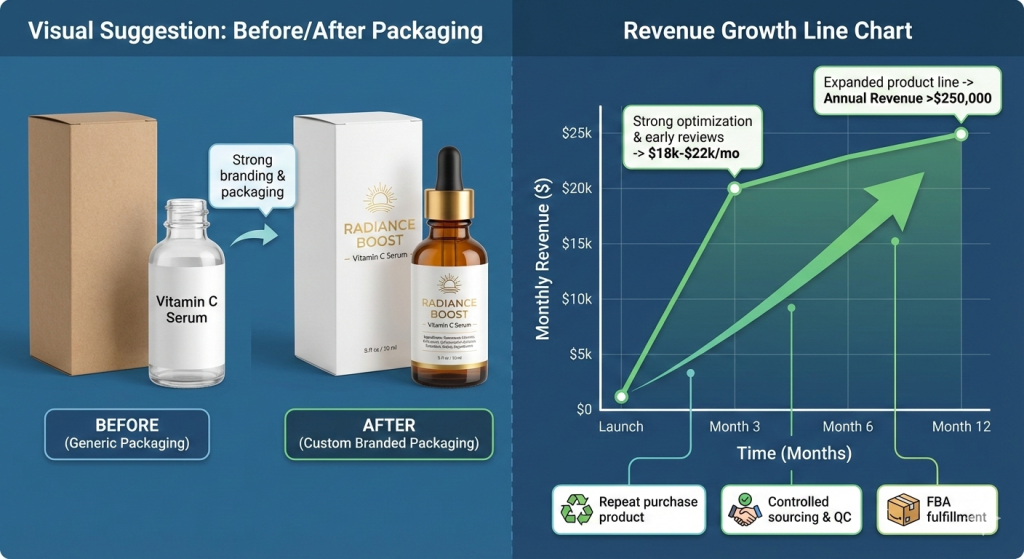
Before/after packaging images + revenue growth line chart
Case Study 2: Private Label Hair Care Product (Hair Growth Oil)
A beauty entrepreneur launched a private label hair growth oil targeting natural hair care customers. The seller sourced from a private label hair products manufacturer in China that offered custom blends and branding. Initial costs were kept low at ~$2,800, including compliance documentation and packaging design.
The product was priced at $24.99, positioned as a premium solution. Within six months, the brand generated $30,000+ in monthly revenue, driven by influencer marketing and SEO-optimized Amazon listings. After one year, the seller introduced complementary products such as shampoo and conditioner, turning a single SKU into a recognizable private label hair care brand.
Estimated Year-1 Revenue: ~$350,000
Net profit margin: ~32%
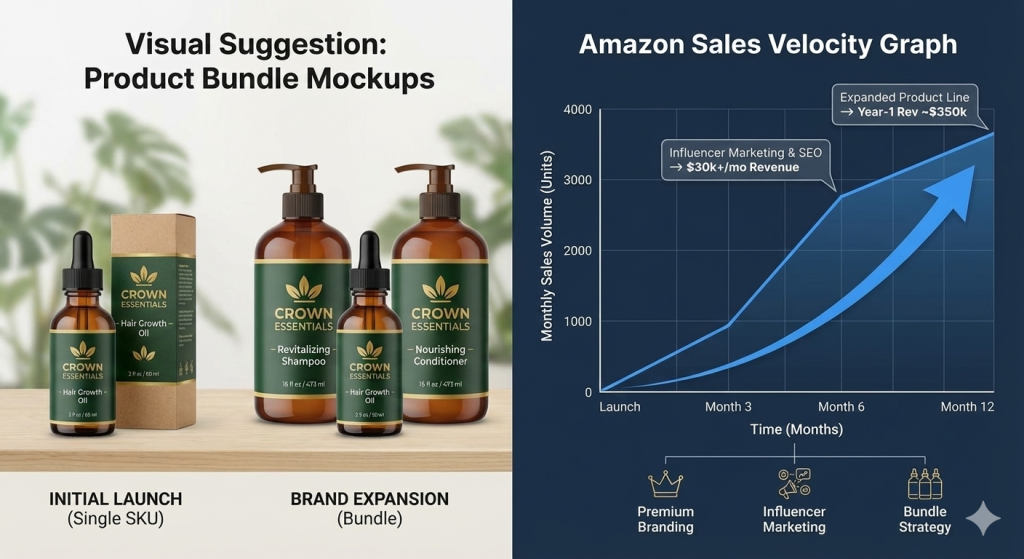
Product bundle mockups + Amazon sales velocity graph
Case Study 3: Private Label Supplements (Ashwagandha Capsules)
A wellness-focused Amazon seller entered the supplement private label market with an Ashwagandha capsule product. Because supplements require strict quality control, the seller partnered with a China sourcing agent to vet GMP-certified manufacturers and handle testing and documentation.
Initial investment was higher — around $6,000 — due to certification, lab testing, and premium packaging. The product launched at $29.99 per bottle and quickly gained traction through keyword targeting like supplement private label and Amazon private label supplements. Monthly sales stabilized at 1,000–1,200 units, generating $30,000–$36,000/month in revenue.
By reinvesting profits, the seller expanded into sleep and immunity supplements, crossing $500,000+ annual revenue by year two.
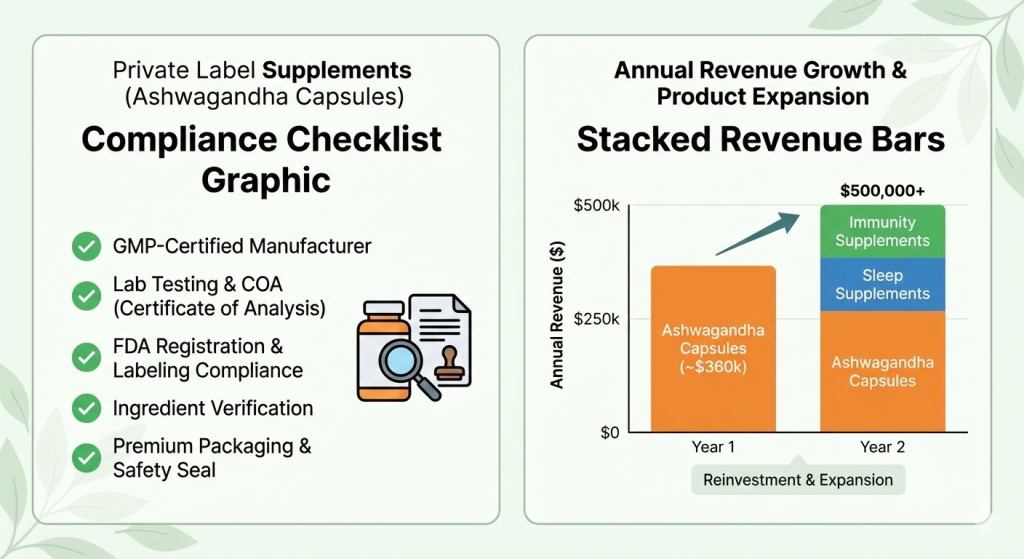
Compliance checklist graphic + stacked revenue bars
| Niche | Initial Investment | Monthly Revenue (Avg) | Profit Margin |
| Skincare (Serum) | $3,500 | $18k–22k | 30–35% |
| Hair Care (Oil) | $2,800 | $25k–30k | ~32% |
| Supplements | $6,000 | $30k–36k | 25–30% |
How China Shaped Private Label & Why a Sourcing Agent Matters
China remains the backbone of global private labeling due to its mature manufacturing ecosystem, customization capabilities, and cost efficiency. China’s manufacturing infrastructure made private labeling globally scalable:
China’s Strengths
- Efficiency & Cost: Large factories producing high volume at lower costs.
- Variety of Niches: From private label clothing to supplement private label lines.
- Custom Packaging: Full customization ability for branding.
Role of a Sourcing Agent
A China sourcing agent helps you:
- Identify reliable manufacturers tailored to your product and quality needs.
- Negotiate better MOQs (minimum order quantities) and prices.
- Manage quality control checks — crucial for beauty products or supplements.
- Coordinate logistics and compliance for export.
Working with an experienced agent boosts your chance of success by minimizing risk and optimizing timelines.
Profitable Private Label Product Categories (With High-Demand Micro Niches)
While broad product categories like beauty or fitness are competitive, the most successful private label brands focus on micro niches—specific customer problems, lifestyles, or use cases. Micro-niche products are easier to rank on Amazon and Google, require lower ad spend, and allow stronger branding. Successful private labeling brands in 2026 focus less on broad categories and more on micro-niches where differentiation, trust, and repeat purchases matter most.
Below is a breakdown of top private label categories with profitable micro-niche ideas, ideal for Amazon FBA sellers, Shopify brands, and online sellers working with China sourcing agents.
Beauty & Personal Care (Highest Margin Category)
Beauty remains one of the most profitable private label categories, especially when broken into problem-specific micro niches.
Private Label Skincare Micro Niches
- Vitamin C serum for hyperpigmentation
- Retinol serum for beginners (low-strength formula)
- Niacinamide serum for oily skin
- Peptide eye cream for dark circles
- Barrier-repair moisturizer for sensitive skin
- Sunscreen for acne-prone skin
- Korean-inspired skincare routines (starter kits)
💡 Why it works:
High repeat purchases + strong branding + premium pricing
Private Label Hair Care Micro Niches
- Hair growth oil for postpartum hair loss
- Sulfate-free shampoo for curly hair
- Scalp serum for dandruff & itch relief
- Heat-protectant spray for styling damage
- Hair masks for chemically treated hair
- Beard growth oil (male grooming niche)
💡 Why it works:
Hair problems are emotional pain points → strong brand loyalty
Private Label Makeup & Cosmetics Micro Niches
- Clean beauty foundation (no parabens)
- Long-lasting matte lipstick for humid climates
- Lash growth serum
- Minimalist makeup kits for beginners
- Travel-size makeup sets
| Category | Est. Search Volume (Monthly) | Avg. Conversion Rate | Profit Margin Potential | Top “Problem-Solution” Trend |
| Skincare | 4.5M+ (High) | 2.7% – 3.0% | 65% – 80% | Barrier Repair (Ceramides/Microbiome) |
| Haircare | 3.2M+ (Medium) | 6.8% (Personal Care) | 55% – 75% | Scalp Health (Red light/Growth oils) |
| Makeup | 2.8M+ (Medium) | 1.9% | 50% – 70% | Clean Beauty (Serum-infused tints) |
Showing monthly search volume estimates for top beauty searches like “sunscreen,” “moisturizer,” “eye cream,” and “conditioner” (from keyword research metrics).
Deep-Dive into Winning Micro-Niches
1. Skincare: The “Scientific Solution” Niche
Skincare remains the largest segment (~40% of the total beauty market). High margins come from “active” ingredients where consumers pay for efficacy rather than volume.
- Today’s Winner: PDRN & Peptide Moisturers. Polydeoxyribonucleotide (PDRN) and miniproteins are seeing a surge in 2025 as consumers move from basic hydration to “bio-regenerative” care.
- Gap in Market: Affordable K-beauty “Starter Kits” for specific barriers (e.g., Menopause-specific skincare or Post-procedure recovery).
2. Haircare: The “Scalp-First” Niche
Haircare has moved beyond simple cleaning to “clinical” treatments.
- Today’s Winner: Growth Therapy. Searches for “hair loss therapy” have spiked over 800%. Consumers are increasingly savvy, looking for rosemary-infused oils and scalp serums that mimic professional clinical results.
- Gap in Market: Postpartum hair loss kits and scalp-detox scrubs with physical and chemical exfoliants.
3. Makeup: The “Masstige” Hybrid Niche
Makeup is currently under pressure to prove “value.” The highest growth is in Cosmeceuticals—makeup that acts like skincare.
- Today’s Winner: Eyelash Growth Serums & Lip Oils. Top lash serums on Amazon are generating over $2.3M in monthly revenue.
- Gap in Market: Humidity-proof matte lip stains that contain Hyaluronic acid, or “Mineral SPF” foundations for acne-prone skin.
Execution Strategy: Profitability Check
Executing private labeling correctly requires a systemized approach—from demand validation and sourcing to branding, compliance, and logistics.
- Landed Cost Target: Aim for a 5x markup (if it costs $4 to make and ship, sell it for at least $20).
- Subscribe & Save: This is your secret weapon. Skincare and Supplements are “replenishment” goods. Brands with high Subscribe & Save enrollment see up to a 1.8x increase in total conversion rates.
- Packaging: 2026 trends favor “Refillable Luxury” and “Travel-sized Sets.” Consumers want to test a brand before committing to a full-sized $40 bottle.
Watch this breakdown of the Amazon Beauty performance and digital strategies to stay ahead
Fitness, Wellness & Supplements (Recurring Revenue Model)
Supplements are one of the best private label products to sell online due to repeat purchases.
Supplement Private Label Micro Niches
- Ashwagandha for stress & sleep
- Collagen peptides for skin & joints
- Magnesium glycinate for sleep support
- Probiotics for women’s gut health
- Hair, skin & nails gummy supplements
- Immunity blends (zinc + vitamin C + elderberry)
💡 Why it works:
Customers reorder monthly → predictable cash flow
⚠️ Note: Always mention compliance, lab testing, and sourcing transparency.
Pet Products (Emotion-Driven Purchases)
Pet owners spend heavily on comfort, health, and safety.
Pet Care Micro Niches
- Calming chews for anxious dogs
- Joint supplements for senior pets
- Grooming brushes for shedding control
- Automatic cat litter box accessories
- Dog paw cleaners for apartments
- Pet dental care kits
💡 Why it works:
Pet owners prioritize quality over price
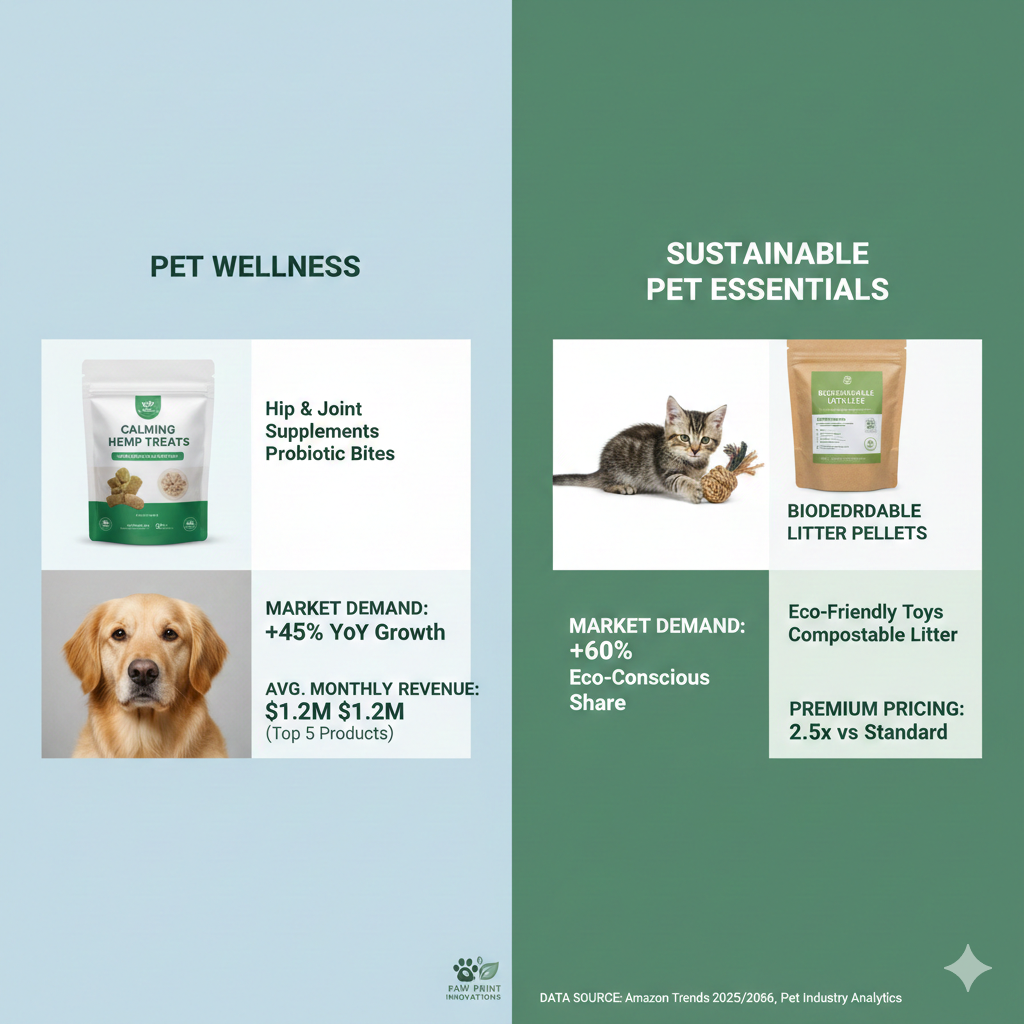
Private label pet product ideas with quick stats on market demand.
Fitness & Home Workout Equipment
Fitness micro niches reduce competition compared to large gym equipment.
Fitness Product Micro Niches
- Resistance bands for physical therapy
- Adjustable dumbbells for apartments
- Foldable treadmill for home offices
- Weighted vests for walking workouts
- Yoga kits for beginners
- Post-workout recovery tools (massage balls, rollers)
💡 Why it works:
Compact, lightweight, easy to ship via Amazon FBA
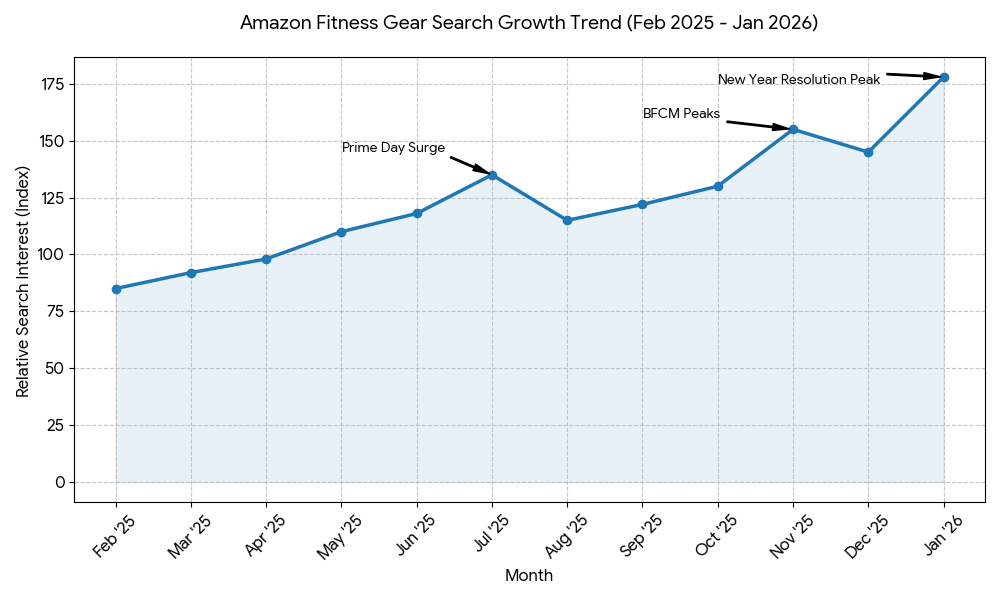
Line chart showing growth trends in fitness gear searches over the last year.
Home, Kitchen & Lifestyle Essentials
Daily-use products generate steady demand and reviews.
Home & Kitchen Micro Niches
- Eco-friendly laundry detergent sheets
- Bamboo kitchen utensil sets
- Refillable cleaning bottles
- Scented candles for stress relief
- Drawer organizers for small apartments
- Minimalist home décor accessories
💡 Why it works:
Low return rates + wide audience appeal.
Fashion, Apparel & Accessories
Private label fashion works best with focused sub-niches.
Clothing & Accessories Micro Niches
- Athleisure wear for home workouts
- Sustainable cotton basics
- Compression socks for travel & office work
- Jewelry for gifting (birthstone, minimal designs)
- Custom makeup bags & organizers
💡 Why it works:
Strong branding + social media marketing potential
Eco-Friendly & Sustainable Goods
Sustainability matters more than ever to modern consumers. Eco-friendly private label products — from reusable household items to biodegradable personal care — can command both emotional and premium value.
Examples include:
✔ Reusable food wraps & bags
✔ Bamboo toothbrushes
✔ Eco-friendly home goods
Why it’s profitable:
- Appeals to environmentally conscious buyers
- Differentiation through sustainable branding
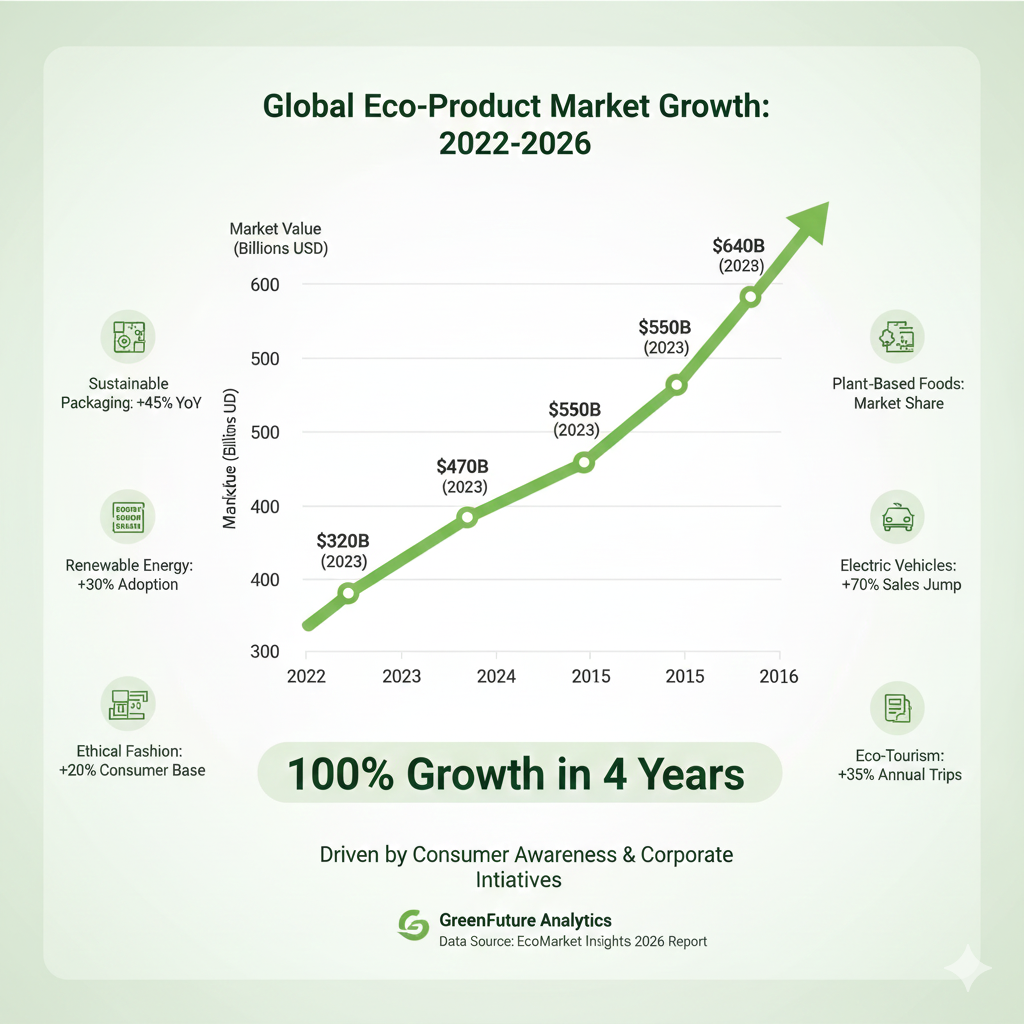
Showing trend growth for eco products year over year.
Health & Supplements
Health and wellness is another high-growth private label niche, particularly for products people buy repeatedly. Supplements such as collagen, probiotics, vitamins, and other organic formulas offer excellent recurring revenue opportunities. With the global supplement market expanding rapidly, brands that offer trusted, high-quality formulations can command premium pricing.
Key products here include:
- Organic supplements (collagen, vitamin blends)
- Immunity boosters and herbal formulas
- Specialty wellness products
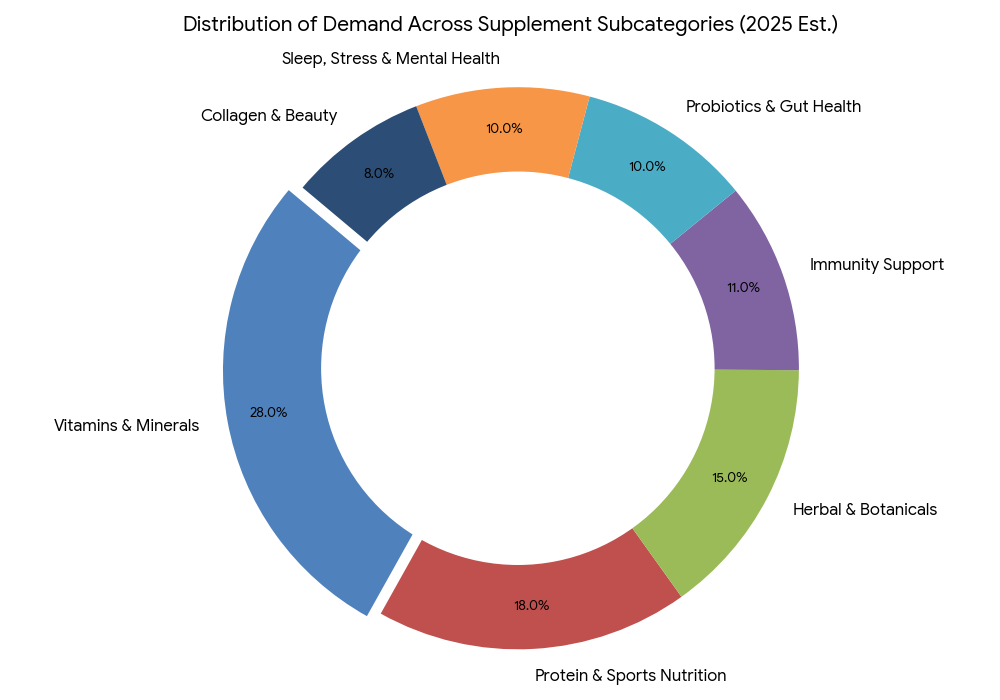
Pie chart showing distribution of demand across supplement subcategories (e.g., immunity, collagen, probiotics).
Quick Data Table – Top Private Label Categories
| Category | Examples | Profit Potential | Consumer Demand |
| Beauty & Skincare | Serums, moisturizers, eye cream | High | High (constant demand) |
| Supplements & Health | Vitamins, collagen | High | Recurring purchase cycles |
| Eco-Friendly Goods | Reusable, bamboo products | Medium–High | Growing trend |
| Fitness Gear | Bands, yoga products | Medium–High | Stable demand |
| Pet Products | Treats, grooming accessories | High | Loyal buyers |
| Home & Kitchen | Décor, utensils | Medium | Always in demand |
Why These Categories Work for Your Private Label Brand
Each category above meets core private label product criteria:
- Easy branding & packaging: Products that can be visually differentiated through logo, design, and quality.
- Repeat purchase potential: Items people buy again (like skincare, supplements).
- High perceived value: Products customers will pay a premium for under your unique brand.
- Lightweight shipping: Lower logistics cost = higher margins.
Why Micro Niches Are Best for Private Label Brands
Micro-niche private label products:
- Rank faster on Amazon & Google
- Require lower advertising budgets
- Create stronger emotional branding
- Reduce price-based competition
- Are easier to source and customize via China manufacturers
This strategy is especially powerful for Amazon private label sellers, Amazon FBA beginners, and brands working with China sourcing agents.
Final Takeaway
The most profitable private label brands don’t sell “skincare” or “fitness gear”—they sell solutions to specific problems. By targeting micro niches within beauty, hair care, supplements, pets, fitness, and home goods, you dramatically increase your chances of building a scalable and defensible private label brand.
How to Start Your Private Label Business (Detailed Steps)
1. Validate Product Demand
Use Amazon research tools, Google Trends, and Shopify data to identify in-demand niches (e.g., private label skin care products).
2. Source Suppliers (China)
Work with agents who can vet factories, obtain samples, and ensure private label manufacturers skin care or supplement private label solutions.
3. Product Customization & Packaging
Design packaging that aligns with your brand identity.
4. Quality Control & Compliance
Ensure products meet regulatory standards (especially for cosmetics or supplements).
5. Launch on Multiple Channels
Sell via Amazon FBA (fulfillment by Amazon), Shopify, or e-commerce sites.
6. SEO & Marketing
Optimize product listings with keywords like private label brand, Amazon private label, sell products online.
7. Scale & Iterate
Use feedback to refine formulas, expand collections, and improve branding.
| Stage | Actionable Steps | Key Tools & Resources | Critical Checkpoint |
| 1. Market Research & Validation | • Identify a Micro-Niche: Don’t just do “Vitamin C Serum.” Do “Vitamin C for sensitive, acne-prone skin.” • Competitor Audit: Read 3-star reviews of top competitors to find their weaknesses (bad smell, sticky texture, broken pumps). • Trend Spotting: Look for rising ingredients (e.g., Snail Mucin, Ashwagandha) or formats (gummies, stick balms). | • Jungle Scout / Helium 10 (Amazon demand) • Google Trends (Search volume) • TikTok Creative Center (Viral trends) • Pinterest Predicts (Aesthetic trends) | Is there a specific “pain point” current products are failing to solve? |
| 2. Product Selection & Formulation | • Ingredients List (INCI): Decide on “Hero Ingredients” vs. fillers. Ensure formula is stable. • Compliance Check: Verify ingredients are legal in target market (FDA for US, CPNP for EU). • Differentiation: Add a unique angle (e.g., eco-friendly, higher potency, patented delivery system). | • FDA Cosmetics Direct (US Regs) • CosIng Database (EU Ingredient laws) • Upwork (Hire a formulation chemist if custom) | Can you clearly explain in one sentence why this product is better than the bestseller? |
| 3. Sourcing & Manufacturing | • Supplier Filtering: Look for manufacturers with GMP (Good Manufacturing Practice) & ISO certifications. • RFQ (Request for Quotation): Ask for MOQ (Minimum Order Quantity), lead times, and “ex-factory” vs. DDP shipping costs. • Verification: Check business license age and trade assurance history. | • Alibaba / Global Sources • ThomasNet (US Manufacturers) • ImportYeti (See who competitors use) • Sourcing Agents (e.g., Jingsourcing) | Does the factory specialize in this specific product type, or do they make “everything”? (Avoid “everything” factories). |
| 4. Samples & Quality Control (QC) | • Golden Sample: Approve one perfect sample that all mass production must match. • Lab Testing: Mandatory for supplements/skincare. Test for heavy metals, microbial growth, and stability. • Third-Party Inspection: Hire an inspector to visit the factory before final payment to check 10-20% of stock. | • QIMA / V-Trust (Quality Inspection Services) • SGS / Eurofins (Lab Testing) • PayPal (Never wire T/T for samples; keep recourse) | Did you test the packaging? (Drop test the bottle, ensure the pump doesn’t jam). |
| 5. Branding, Packaging & Compliance | • Visual Identity: Create a “thumb-stopping” design. The bottle is the marketing. • Regulatory Labeling: Must have correct font sizes, ingredient lists, “Distributed by” address, and warning labels. • Unboxing Experience: Design the secondary packaging (box/mailer) to encourage social sharing. | • 99designs / Dribbble (Designers) • Packlane (Custom boxes) • GS1 (Buy official UPC barcodes) • MoCRA (New US cosmetic regulations) | Does the packaging look premium enough to justify your price point? |
| 6. Logistics & Launch Prep | • Shipping Method: Air Express (fast, expensive) vs. Sea Freight (slow, cheap). • 3PL vs. FBA: Decide if Amazon fulfills (FBA) or a third-party warehouse (3PL) for Shopify orders. • Listing Optimization: High-res lifestyle photos, infographic images, and SEO-rich title/bullets. | • Freightos (Compare shipping quotes) • Flexport (Freight forwarding) • Soona (Virtual product photography) | Have you calculated your “Landed Cost” (Product + Shipping + Duty) to ensure profit margin? |
| 7. Launch & Traction (The “Push”) | • Amazon Vine: Enrol for early reviews. • Influencer Seeding: Send PR packages to 50 micro-influencers (TikTok/IG) 2 weeks before launch. • PPC Campaign: Turn on Amazon Sponsored Products or Meta Ads targeting competitor keywords. • Email/SMS: Capture leads early with a “Coming Soon” page. | • Klaviyo (Email Marketing) • Amazon Seller Central (PPC) • Shopify Collabs (Influencer management) | Do you have at least 15 reviews planned/expected within the first 30 days? |
| 8. Scaling & Retention | • Subscribe & Save: Crucial for supplements/skincare (recurring revenue). • Cross-Sell: Launch a complementary product (e.g., if selling shampoo, launch conditioner). • Omnichannel: Expand from Amazon to Shopify (or vice versa) and explore retail wholesale. | • Recharge (Subscriptions) • Faire (Wholesale marketplace) • Google Analytics 4 (Data tracking) | Is your Customer Lifetime Value (LTV) higher than your Customer Acquisition Cost (CAC)? |
The “Perfect” RFQ Template (For China Manufacturers)
Pro tip: How to Analyze a Competitor
Since I don’t have your specific link, here is the exact method I use to find “gaps” in the market. Use this on your top competitor.
The “3-Star Review” Method
Ignore 5-star reviews (often fake/paid) and 1-star reviews (often shipping issues). 3-star reviews are honest customers who liked the product but found a specific flaw.
Look for these specific keywords in reviews:
| Category | What to Search For | The Opportunity (Your Selling Point) |
| Sensory | “Smells like chemicals,” “Too sticky,” “Greasy,” “Gritty taste” | Your Fix: “Our formula is non-sticky and smells like fresh oranges.” |
| Packaging | “Pump broke,” “Leaked in box,” “Dropper doesn’t reach bottom” | Your Fix: Use an airless pump bottle or higher quality seal. |
| Results | “Dried out my skin,” “Caused breakouts,” “Stomach ache (supplements)” | Your Fix: Add soothing ingredients (Aloe/Chamomile) or use a gentler form of Vitamin C. |
| Value | “Bottle was half full,” “Too expensive for the size” | Your Fix: Fill to the brim or offer a “Jumbo” size. |
Common Challenges in Private labelling and How to Overcome Them
Challenges
- High upfront MOQ and inventory risk.
- Competition in saturated niches.
- Quality control and product consistency.
Solutions
- Start small with restricted variants and test via dropshipping.
- Use customer feedback to refine products before larger orders.
- Partner with agents for inspection and compliance.
- Competition — differentiate with unique packaging and branding.
- Quality control issues — hiring agents improves QC
Most failures in private labeling occur not because of poor ideas, but due to weak sourcing decisions, lack of quality control, or unrealistic cost assumptions.
Conclusion: Building a Profitable Private Label Brand Is About Strategy, Not Luck
Private labeling is not a shortcut—it’s a structured business model that rewards strategy, execution, and long-term thinking. The brands that succeed in 2026 are not the ones chasing viral products or copying bestsellers. They are the ones that identify specific problems, target micro niches, and deliver consistently high-quality products under a trusted brand name.
As you’ve seen throughout this guide, private label success follows clear patterns:
- Focused niches outperform broad categories
- Repeat-purchase products outperform one-time buys
- Strong sourcing and quality control outperform aggressive marketing
- Brand equity outperforms price competition
Categories like private label skincare, hair care, supplements, pet products, and fitness accessories continue to dominate because they combine emotional buying behavior with recurring demand. When paired with Amazon FBA, Shopify, and SEO-driven marketing, private labeling becomes one of the most scalable online business models available today.
China remains at the center of this ecosystem—not just because of cost advantages, but because of its ability to support custom formulations, branded packaging, and large-scale production. That said, sourcing is also where most new sellers fail. Choosing the wrong supplier, skipping quality control, or misunderstanding compliance can turn a promising idea into an expensive mistake.
That’s why successful brands treat sourcing as a strategic function—not an afterthought. Working with the right manufacturers, using proper inspections, and partnering with experienced China sourcing agents dramatically reduces risk and shortens the path to profitability.
The takeaway is simple:
The most profitable private label brands don’t sell products—they sell solutions, backed by branding, quality, and trust.
If you approach private labeling with the right mindset, the right niche, and the right sourcing strategy, you’re not just launching a product—you’re building an asset that can grow, expand, and compound in value over time.
When done correctly, private labeling becomes a long-term asset—combining product control, customer trust, and scalable growth into a defensible ecommerce brand. Want to learn more…

