

Incoterms Guide 2026: Critical Truths About Incoterms 2020 (What Importers & Exporters Must Know)
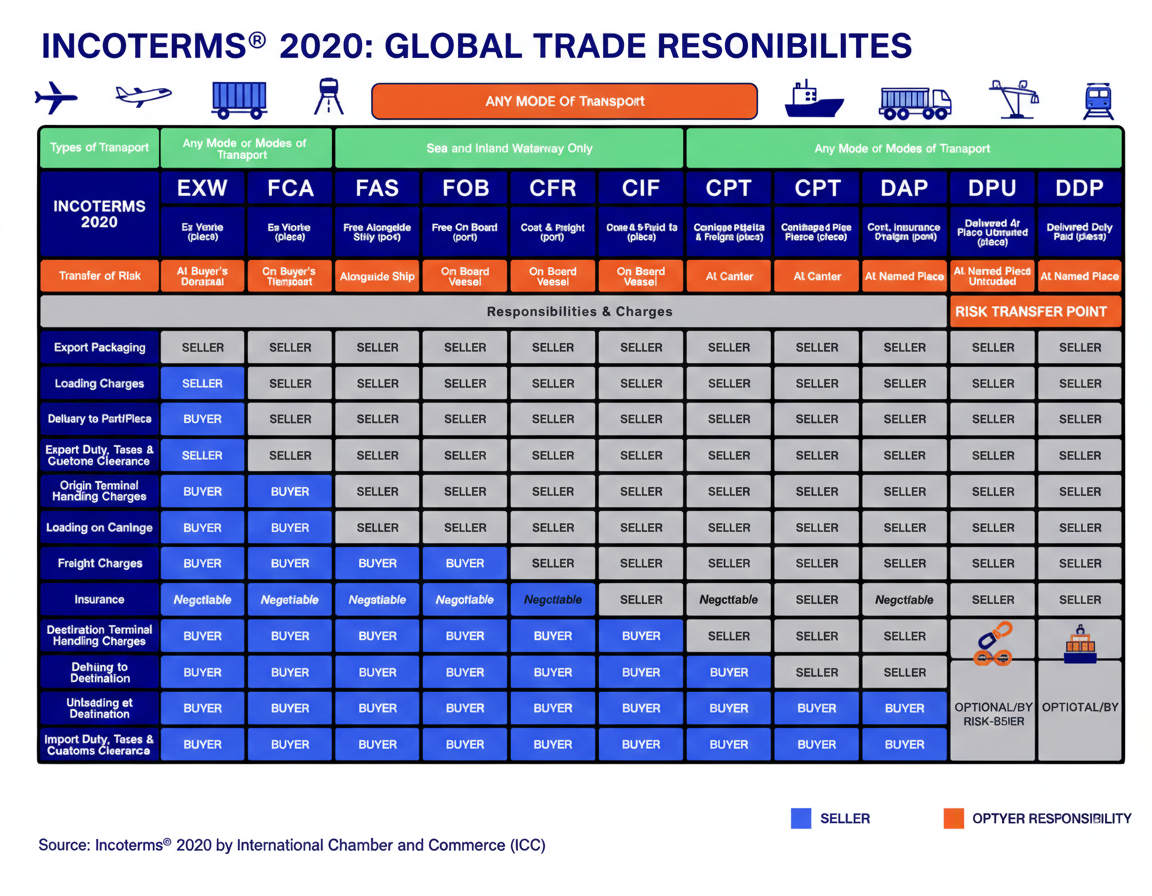
International shipping involves more than just moving goods from one country to another. Costs, risks, insurance, customs clearance, and delivery responsibilities all need to be clearly defined. This is where Incoterms—short for International Commercial Terms—play a critical role.
Incoterms are standardized shipping terms published by the International Chamber of Commerce (ICC). They clearly define the responsibilities of buyers and sellers in international trade, helping businesses avoid confusion, disputes, and unexpected costs. The latest official version in use today is Incoterms 2020, which applies to global shipping contracts across industries.
In this guide, we’ll break down shipping Incoterms, explain how they work, and walk through each term in simple language—so you can choose the right Incoterm for your business.
What Are Incoterms? Meaning & Purpose
Incoterms Meaning & Definition
Incoterms are internationally recognized commercial terms that describe how goods are delivered from a seller to a buyer. Each Incoterm defines:
- Who arranges transportation
- Who pays shipping costs
- When risk transfers from seller to buyer
- Who handles insurance, customs, and duties
In short, Incoterms act as a common shipping language for global trade. When both parties agree on an Incoterm, expectations are clear before the shipment even begins.
Why Use Incoterms in Shipping Contracts
Using Incoterms in shipping contracts reduces misunderstandings and protects both buyers and sellers. Without them, disputes often arise over damaged goods, delayed shipments, or unexpected customs charges.
Incoterms help by:
- Clarifying risk transfer points
- Defining cost responsibility
- Supporting smoother international logistics
- Reducing legal and operational conflicts
It’s important to note that Incoterms are not laws. They only apply when explicitly stated in a sales contract.
Overview of Incoterms 2020
Incoterms 2020 Summary
The Incoterms 2020 rules include 11 shipping terms, divided into two main categories:
- Terms for all modes of transport
- Terms for sea and inland waterway transport only
Here’s a simplified overview:
- EXW – Ex Works
- FCA – Free Carrier
- CPT – Carriage Paid To
- CIP – Carriage and Insurance Paid To
- DAP – Delivered at Place
- DPU – Delivered at Place Unloaded
- DDP – Delivered Duty Paid
- FAS – Free Alongside Ship
- FOB – Free on Board
- CFR – Cost and Freight
- CIF – Cost, Insurance and Freight
Key Updates From Incoterms 2010
One of the most notable updates in Incoterms 2020 was the replacement of DAT (Delivered at Terminal) with DPU (Delivered at Place Unloaded). This change allows delivery at any agreed location not just terminals making the rule more flexible for modern supply chains.
Incoterms for All Transport Modes
These Incoterms can be used for air freight, road, rail, and sea shipping.
EXW – Ex Works
Under EXW (Ex Works), the seller’s responsibility is minimal. The seller makes the goods available at their premises, and the buyer handles everything else—transport, export clearance, risk, and costs.
- Best for sellers who want minimal involvement
- High responsibility and risk for buyers
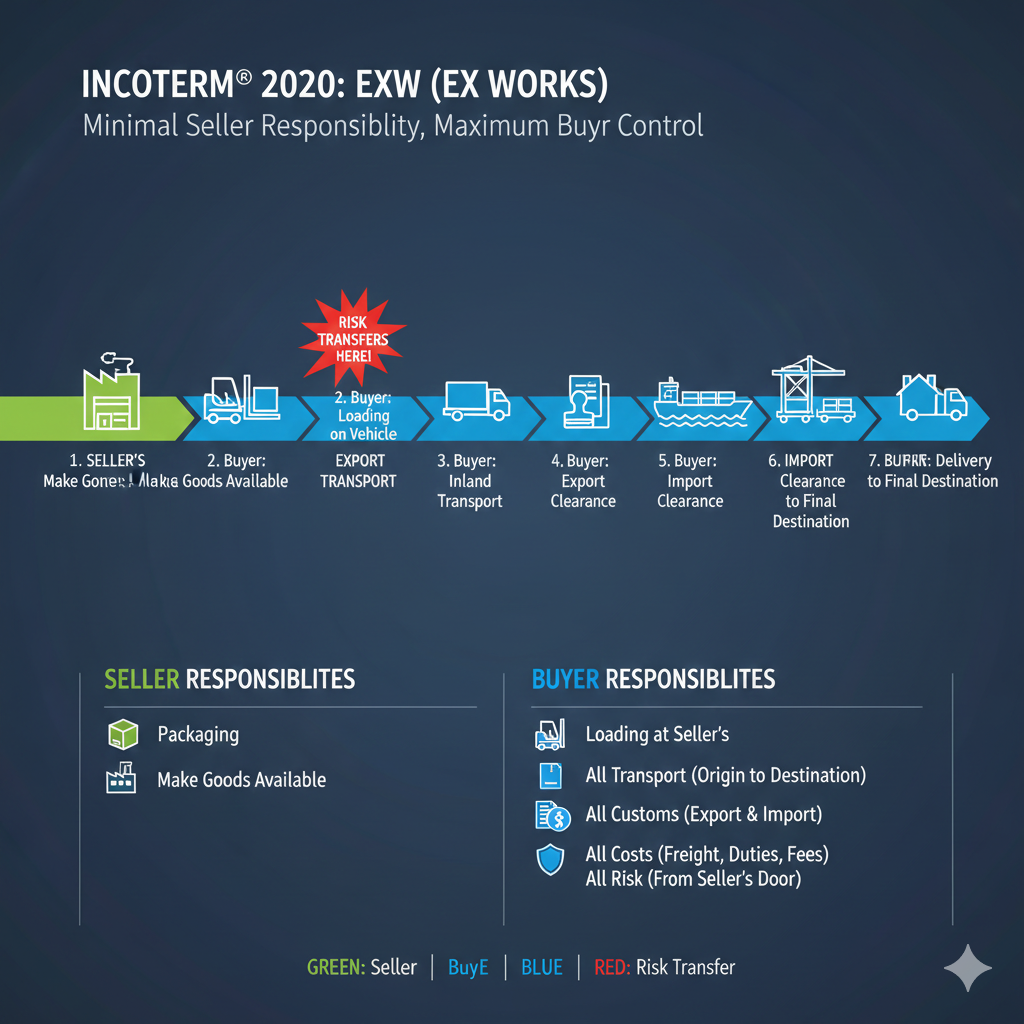
Warehouse-to-destination responsibility diagram for EXW Incoterms.
FCA – Free Carrier
With FCA, the seller delivers goods to a carrier or location specified by the buyer. Once delivered, the risk transfers to the buyer.
- More balanced than EXW
- Common in containerized shipping
- Often preferred over FOB for modern logistics
CPT – Carriage Paid To
Under CPT, the seller pays for transportation to the destination, but risk transfers once the goods are handed to the first carrier.
- Seller pays freight
- Buyer carries transit risk
- Suitable for multimodal shipments
CIP – Carriage and Insurance Paid To
CIP is similar to CPT, but with one key difference: the seller must also provide insurance coverage for the shipment.
- Seller pays freight and insurance
- Buyer assumes risk earlier
- Common for high-value goods
DAP – Delivered at Place
With DAP, the seller delivers the goods to an agreed destination, ready for unloading. The buyer handles unloading, import duties, and taxes.
- Seller manages most logistics
- Buyer handles customs clearance
- Popular for international B2B shipments
DPU – Delivered at Place Unloaded
DPU requires the seller to deliver and unload the goods at the destination. Risk transfers only after unloading is complete.
- Maximum seller responsibility (except duties)
- Requires suitable unloading facilities
- Replaced DAT in Incoterms 2020
DDP – Delivered Duty Paid
DDP places the highest obligation on the seller. The seller is responsible for transport, customs clearance, duties, and taxes until the goods reach the buyer.
- Most convenient for buyers
- High risk and cost for sellers
- Common in eCommerce and Alibaba DDP shipments
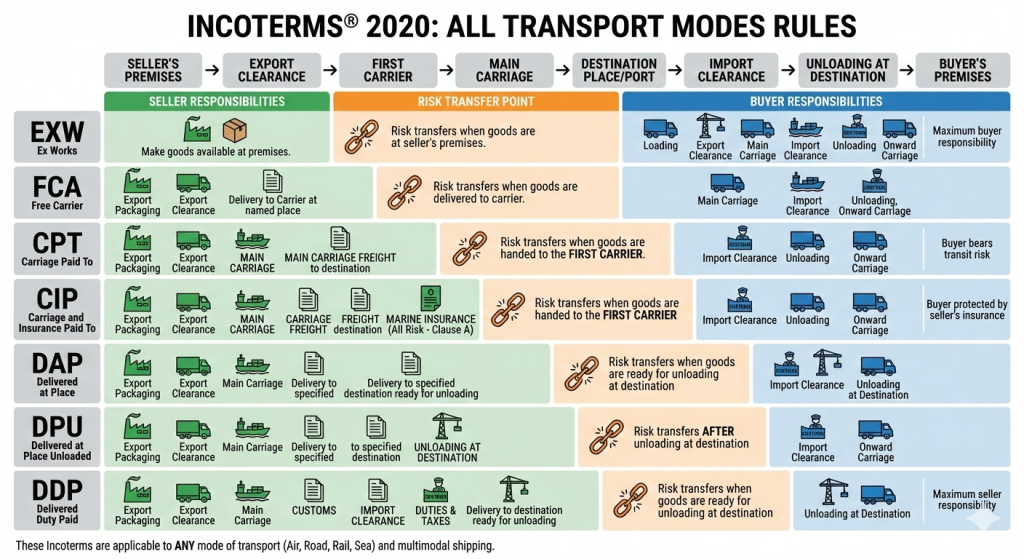
Full end-to-end responsibility flow of Incoterms for type of shipping’s.
Incoterms for Sea & Waterway Transport
These Incoterms apply only to sea and inland waterway shipping.
FAS – Free Alongside Ship
Under FAS, the seller delivers goods alongside the vessel at the port of shipment. The buyer handles loading, freight, and risk from that point.
- Used mainly for bulk cargo
- Buyer controls shipping process
FOB – Free on Board
FOB means the seller loads the goods onto the vessel at the port of origin. Risk transfers once the goods are on board.
- Widely used in sea freight
- Not ideal for containerized cargo
- Still common in traditional trade contracts
CFR – Cost and Freight
With CFR, the seller pays for freight to the destination port, but risk transfers when goods are loaded onto the ship.
- Seller pays shipping
- Buyer assumes sea transit risk
- Insurance not included
CIF – Cost, Insurance and Freight
CIF builds on CFR by requiring the seller to also purchase marine insurance.
- Seller pays freight and insurance
- Buyer gains additional protection
- Common in international commodity trade
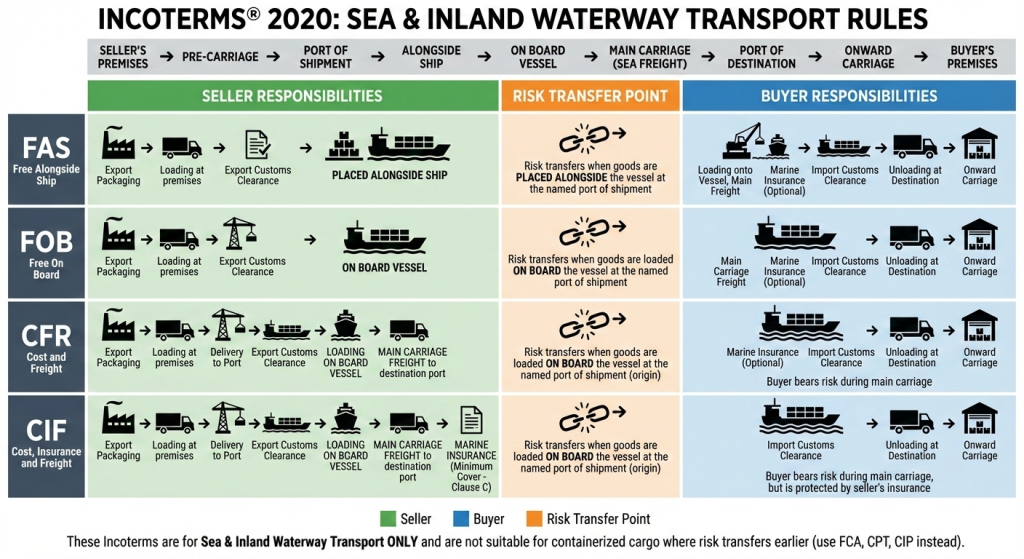
Sea freight timeline showing risk transfer points
Final Thoughts: Choosing the Right Incoterm
Understanding shipping Incoterms is essential for anyone involved in international trade. The right Incoterm can reduce costs, limit risk, and improve supply chain efficiency—while the wrong one can lead to delays and disputes.
Always:
- Match the Incoterm to your transport mode
- Clearly state “Incoterms 2020” in contracts
- Understand where cost and risk transfer occurs
If you regularly import or export goods, mastering Incoterms is not optional—it’s a competitive advantage.
Incoterms Decision Guide – When to Use Which
Choosing the right Incoterm depends on your role in the transaction (importer or exporter), your control preferences, risk tolerance, and mode of transport. A smart selection minimizes costs and prevents surprises.
Best Incoterms for Importers
For importers focused on control and cost efficiency:
DDP (Delivered Duty Paid)
- Best for buyers who want minimal logistics hassle — the seller handles transportation, export and import customs, duties, and delivery up to your location.
- Offers convenience but places high responsibility on the seller — including tariff risk and compliance.
CIF (Cost, Insurance & Freight)
- Useful if you want some insurance included and clarity at the destination port but plan to arrange import clearance yourself.
- The seller arranges minimum insurance and freight to destination; you still handle duties and inland delivery.
FOB (Free on Board)
- Gives you better control over freight costs and carriers because you arrange the main freight.
- Risk transfers once goods are on board the vessel — you handle insurance and import responsibilities.
Best Incoterms for Exporters
Exporters often prioritize risk limitation, predictability, and ease of compliance:
EXW (Ex Works)
- Minimizes seller obligations — buyer arranges transport and export customs.
- Good if you want low involvement in logistics, but can deter buyers who prefer sellers to handle export clearance.
FCA (Free Carrier)
- A balanced choice: the seller delivers goods to a carrier at a specified place and clears them for export — buyer handles onward logistics.
- Applicable to all transport modes.
CPT (Carriage Paid To)
- Seller pays transport to a named destination but risk transfers earlier, which helps control logistics while shifting risk to buyer.
- Good for exporters who want to include freight costs without full liability.
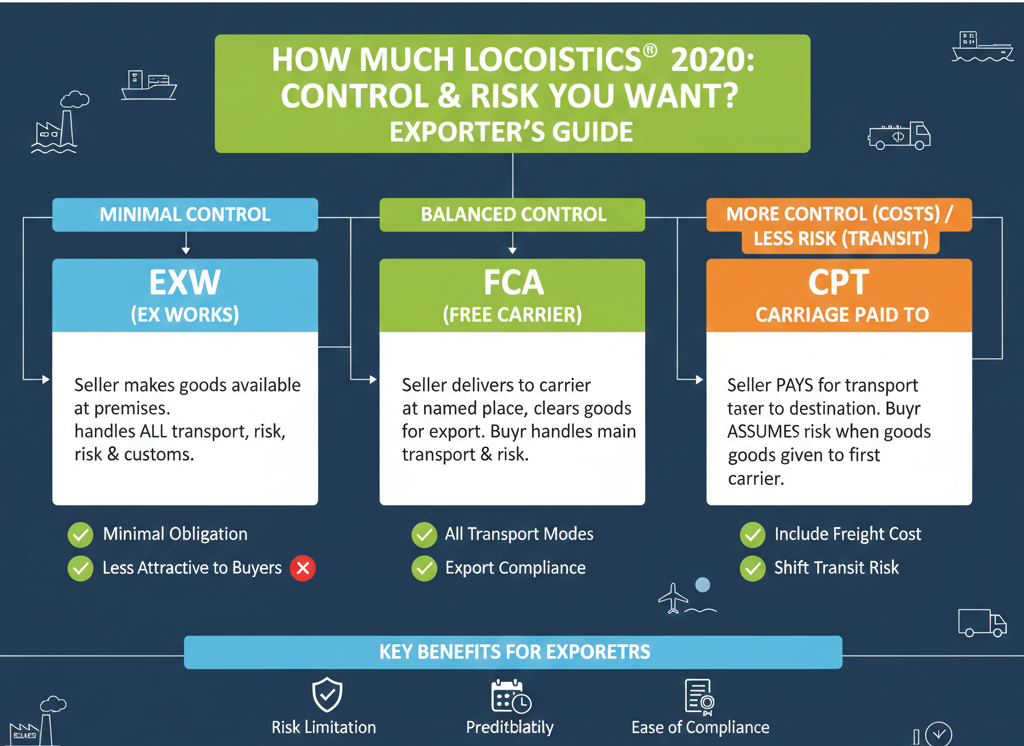
Common term choices for exporters based on how much logistics control and risk they’re willing to take.
Incoterms for Air vs. Sea Freight
Most Incoterms can be used across transport modes like air, land, and multimodal. However, some are designed for sea and inland waterway transport only:
- FAS (Free Alongside Ship)
- FOB (Free on Board)
- CFR (Cost and Freight)
- CIF (Cost, Insurance and Freight)
These should be used only when shipping by sea or waterways.
For air freight and containerized shipments, terms like FCA, CPT, CIP, DAP, DPU, and DDP are more appropriate because they align with modern transport practices.
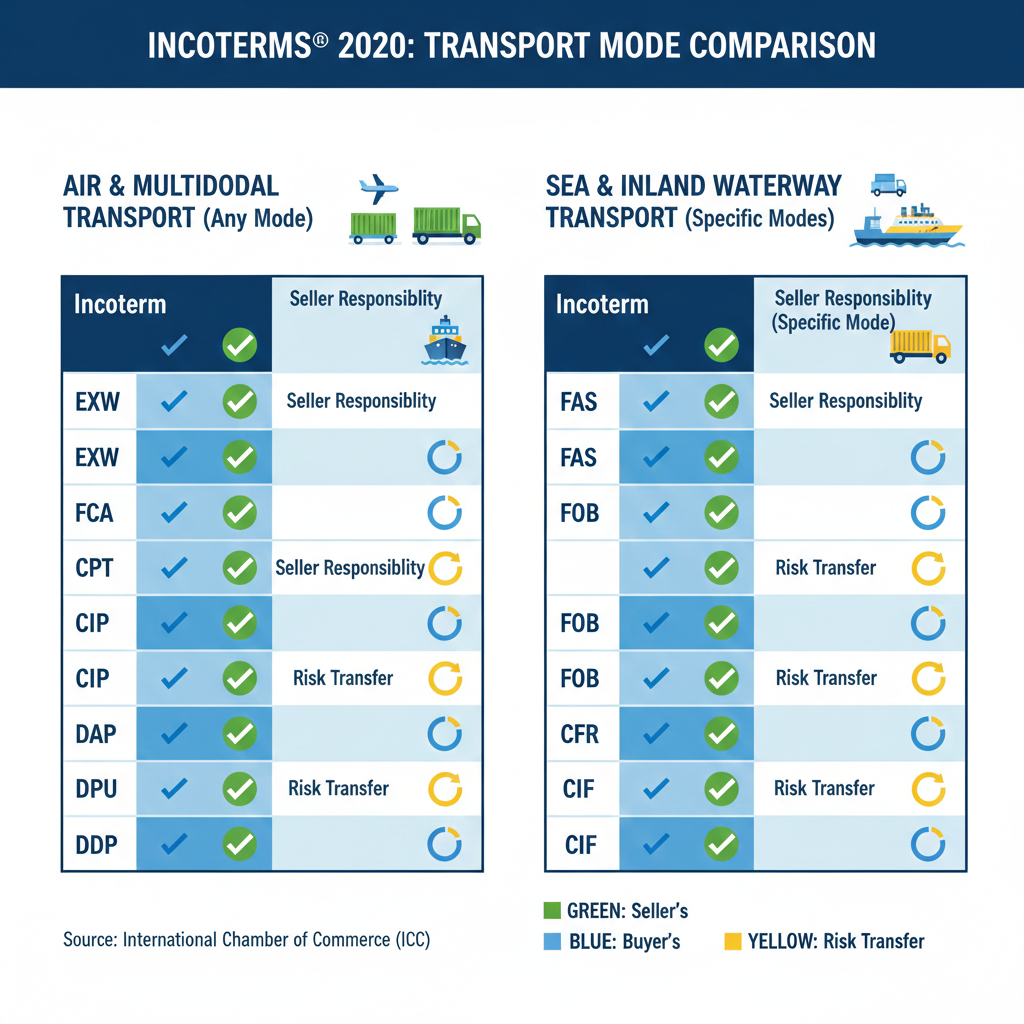
Incoterms by transport mode — Air/Multimodal vs Sea-specific.
Common Incoterms Mistakes & Tips
Even experienced traders can misapply Incoterms. Understanding common pitfalls helps protect your time and money.
Forgetting Insurance (CIF vs CFR)
A recurring error is confusing CFR and CIF:
- Under CFR (Cost and Freight), the seller pays freight to the port of destination, but does not provide insurance.
- Under CIF, the seller must provide at least minimum insurance coverage, which protects the buyer during main transit.
Tip: If the cargo value is high, verify that the insurance level (even under CIF) meets your risk appetite — sometimes additional coverage is needed.
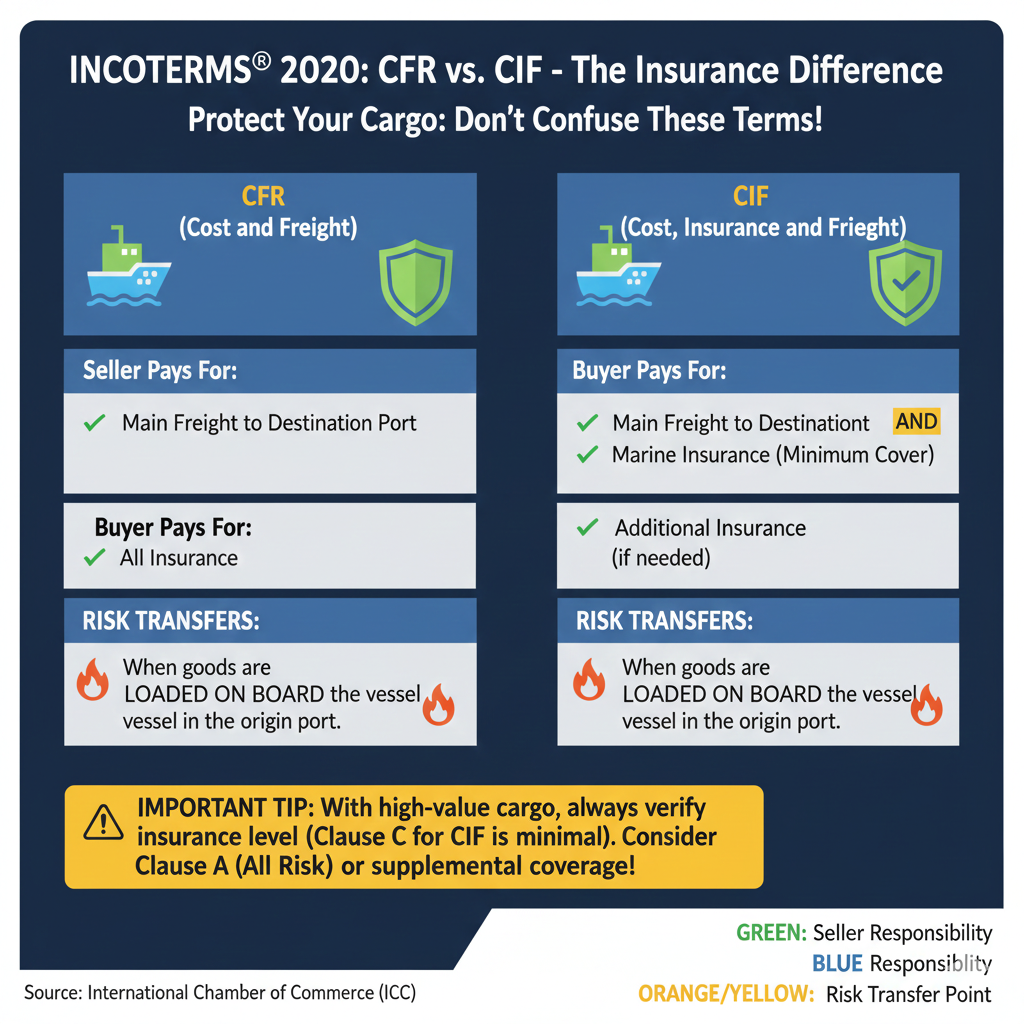
CFR vs CIF — who pays freight, who pays insurance, and risk transfer point.
Misunderstanding Delivery Points
Common confusion arises around where responsibility truly ends for different terms:
- Under DAP (Delivered at Place), the seller delivers goods ready for unloading but does not handle import clearance or duties.
- Under DDP (Delivered Duty Paid), the seller covers delivery, unloading, and all customs/duties at destination.
Failing to specify the exact place (e.g., just saying “Port X” instead of “Warehouse Y at Port X”) can cause disputes and unexpected warehousing charges.
Misuse in Alibaba Transactions
Many first-time buyers on platforms like Alibaba choose DAP without understanding its implications:
- With DAP, the buyer is responsible for import customs and duties once the goods arrive at the agreed destination.
This means you may still face local fees and clearance tasks — something beginners often overlook.
If you prefer a hassle-free door-to-door service, DDP shipping might seem ideal — but be careful: real DDP arrangements place the seller (or their freight forwarder acting as importer of record) in charge of duties and documentation, which can create compliance and tax challenges if not done correctly.
Incoterms 2020 Chart
Here is a comprehensive reference chart for Incoterms 2020.
This chart breaks down the 11 rules into the three key areas you requested: Responsibilities, Risk Transfer, and Costs (Shipping, Insurance, Customs).
Incoterms 2020 Reference Chart
| Incoterm | Full Name | Mode of Transport | Risk Transfers From Seller to Buyer | Export Customs | Main Carriage (Freight) | Insurance | Import Customs |
|---|---|---|---|---|---|---|---|
| EXW | Ex Works | Any | At Seller’s premises (before loading) | Buyer | Buyer | Buyer (No obligation) | Buyer |
| FCA | Free Carrier | Any | When delivered to carrier at named place | Seller | Buyer | Buyer (No obligation) | Buyer |
| FAS | Free Alongside Ship | Sea/Inland | When goods are placed alongside ship | Seller | Buyer | Buyer (No obligation) | Buyer |
| FOB | Free On Board | Sea/Inland | When goods are loaded on board the vessel | Seller | Buyer | Buyer (No obligation) | Buyer |
| CFR | Cost and Freight | Sea/Inland | When goods are loaded on board the vessel | Seller | Seller | Buyer (No obligation) | Buyer |
| CIF | Cost, Insur. & Freight | Sea/Inland | When goods are loaded on board the vessel | Seller | Seller | Seller (Min. Cover – Clause C) | Buyer |
| CPT | Carriage Paid To | Any | When handed to the first carrier | Seller | Seller | Buyer (No obligation) | Buyer |
| CIP | Carriage & Insur. Paid To | Any | When handed to the first carrier | Seller | Seller | Seller (All Risk – Clause A) | Buyer |
| DAP | Delivered at Place | Any | At destination, ready for unloading | Seller | Seller | Seller (No obligation) | Buyer |
| DPU | Delivered at Place Unloaded | Any | At destination, once unloaded | Seller | Seller | Seller (No obligation) | Buyer |
| DDP | Delivered Duty Paid | Any | At destination, ready for unloading | Seller | Seller | Seller (No obligation) | Seller |
Incoterms 2020 Chart of Responsibility Diagram
Key Breakdowns
1. Seller vs. Buyer Responsibilities
- Extreme Buyer Responsibility (EXW): The buyer does almost everything. They must even load the truck at the seller’s warehouse and clear export customs.
- Extreme Seller Responsibility (DDP): The seller does almost everything, including paying import taxes/VAT in the buyer’s country.
- The “Middle” Ground (F-Terms): The seller gets the goods to a transport hub (port or terminal), and the buyer takes over from there.
2. Where Risk Transfers
This is the most critical distinction, especially for the “C” terms (CFR, CIF, CPT, CIP).
- Critical Split: In “C” terms, the seller pays for the shipping to the destination, BUT the risk transfers to the buyer as soon as the goods are handed to the carrier (or loaded on the boat) at the origin.
- Example: If you use CIF New York (shipping from London), the seller pays the freight to New York. However, if the ship sinks in the Atlantic, the Buyer carries that risk (and must file the insurance claim).
3. Who Pays for Insurance?
Only two terms explicitly require the seller to buy insurance:
- CIF (Sea only): Seller must buy “Institute Cargo Clauses (C)” coverage (minimum cover).
- CIP (Any mode): Seller must buy “Institute Cargo Clauses (A)” coverage (all-risk cover). This was a major upgrade in the 2020 rules.
- All Other Terms: Insurance is not mandatory by rule. However, standard practice is that whoever holds the risk (see the Risk Transfer column) should pay for insurance to protect their own interest.
4. Customs & Duties
- Export Customs: Seller pays in all cases EXCEPT EXW (Ex Works).
- Import Customs: Buyer pays in all cases EXCEPT DDP (Delivered Duty Paid).
Checklist for a specific shipment you are planning to ensure you don’t miss a hidden cost?
Conclusion — Mastering Shipping Incoterms
Understanding Incoterms is essential in global trade — not optional. The right choice leads to clear cost allocation, risk management, and smoother logistics. Whether you’re new to import/export or a seasoned professional, knowing when to use terms like DDP, FOB, EXW, or CIF shipping gives you a competitive edge.
Take action:
✔ Download your Incoterms 2020 chart
✔ Share it with your team
✔ Subscribe for more trade and logistics insights
Before you finalize any contract, always verify the exact term, version year, and delivery location clarity saves money and avoids disputes. Learn more….
What are Incoterms in shipping?
Incoterms are standardized international trade terms published by the International Chamber of Commerce (ICC). They define who is responsible for shipping costs, insurance, customs clearance, and risk transfer in international shipments.
What does Incoterms 2020 mean?
Incoterms 2020 refers to the latest official version of Incoterms rules, effective from January 1, 2020. It includes 11 trade terms that apply to domestic and international shipping when stated in contracts.
What is the difference between EXW and FCA Incoterms?
Under EXW (Ex Works), the buyer takes almost all responsibility from the seller’s premises. Under FCA (Free Carrier), the seller delivers goods to a carrier and clears them for export, making FCA more practical for international shipping.
What is the difference between CIF and CFR shipping terms?
The key difference is insurance.
- CFR (Cost and Freight): Seller pays freight but does not provide insurance.
- CIF (Cost, Insurance and Freight): Seller pays freight and minimum insurance coverage.
What does DDP shipping mean?
DDP (Delivered Duty Paid) means the seller is responsible for delivering goods to the buyer’s location while covering all costs, including shipping, customs clearance, duties, and taxes.
What is the difference between DAP and DDP Incoterms?
With DAP (Delivered at Place), the seller delivers goods ready for unloading, but the buyer handles import duties and taxes. With DDP, the seller covers all customs duties and taxes as well.
Which Incoterms are best for importers?
Importers often prefer DDP, CIF, or FOB, depending on how much control they want over shipping, insurance, and customs clearance.
Which Incoterms are best for exporters?
Exporters commonly use EXW, FCA, or CPT to limit risk exposure while maintaining predictable logistics responsibilities.
Which Incoterms are used for sea freight only?
The Incoterms that apply only to sea and inland waterway transport are FAS, FOB, CFR, and CIF. All other Incoterms can be used for air, road, rail, or multimodal transport.
Are Incoterms legally binding?
Incoterms are not laws. They become legally binding only when explicitly stated in a sales contract, including the version (e.g., “Incoterms® 2020”) and the named delivery place.

